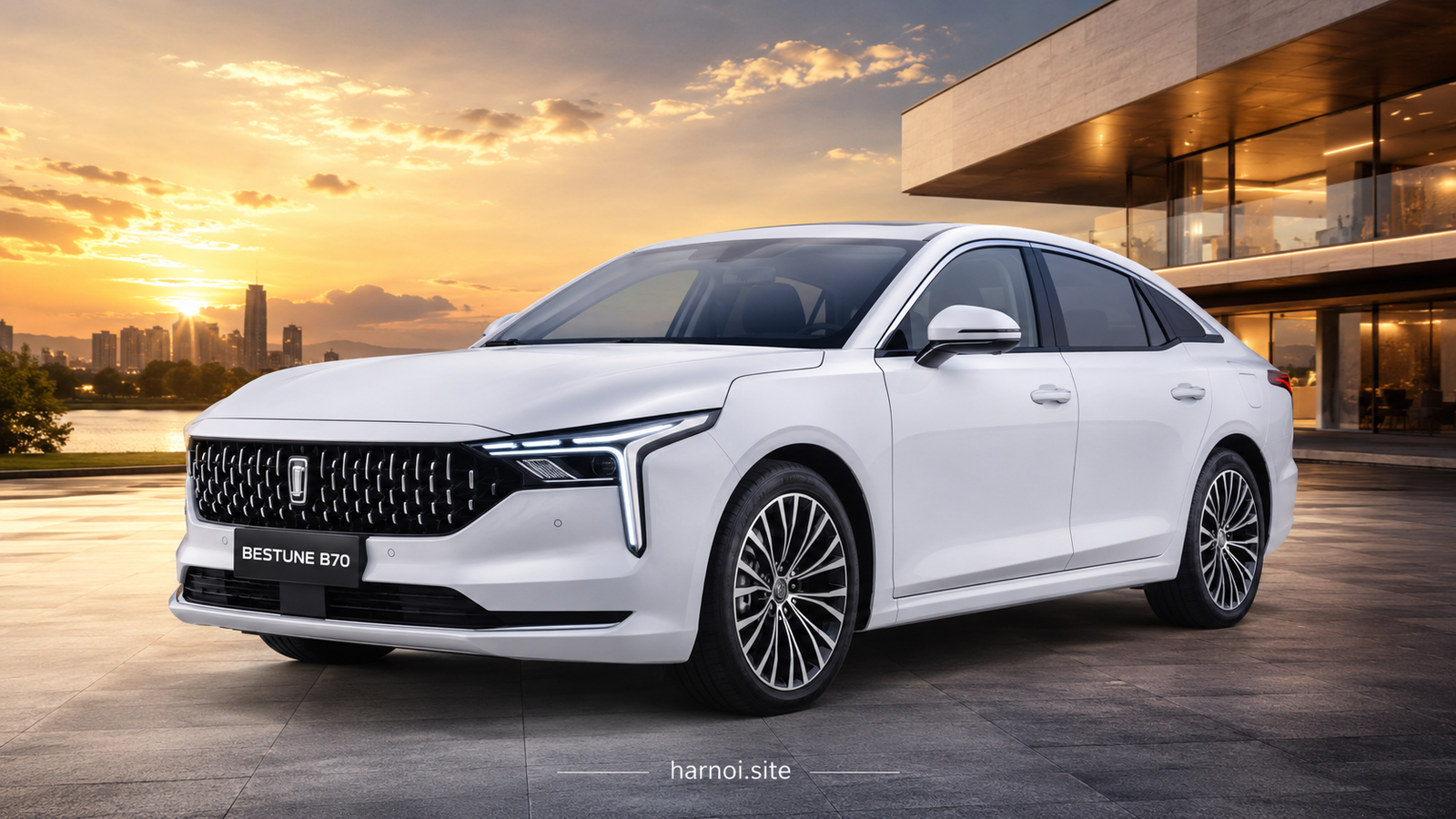
Overview of the Bestune B70 Sedan
The Bestune B70 is a mid-size sedan built by FAW Group under its Bestune brand. The nameplate has been around since 2006, originally sharing its underpinnings with the Mazda6, but the current (third) generation is a clean-sheet design built on FAW’s own FMA (FAW Modular Architecture) platform. It’s positioned as a value-forward alternative to established mid-size sedans like the Toyota Camry, Honda Accord, Hyundai Sonata, and Kia K5, aiming to win buyers over with a long feature list, bold styling, and a lower price tag. It’s sold across several Middle Eastern and Asian markets, including the UAE and Saudi Arabia, where Chinese brands have been rapidly gaining ground.
Exterior Design
The B70 wears a distinctive front fascia with a knotted, mesh-style grille and an emblem that some reviewers say evokes a Lincoln-like presence. The body is a sportback-style sedan — essentially a four-door with a liftback-style rear hatch — which gives it a coupe-ish roofline while retaining hatchback practicality. Highlights include a rear lip spoiler, dual square exhaust tips, and wraparound taillamps that stretch across the trunk lid. Wheel sizes vary by trim, from 18-inch alloys on base Comfort trims up to 19-inch wheels on the range-topping Limousine trim.
Interior Design and Comfort
Inside, the B70 leans heavily on screens. The dashboard typically features a digital instrument cluster paired with a large central touchscreen, and higher trims add a third, smaller display dedicated to climate controls, operated with a mix of touch input and physical chrome-finished dials. Leather or leather-style upholstery, some with cooling/ventilation, is available on upper trims, and the cabin has a double-deck center console design that adds extra hidden storage. Rear seat space is generous thanks to the long 2,800 mm wheelbase, with enough legroom and headroom for adults even though the sloped roofline slightly narrows the rear window’s view.
Engine Specifications
The B70 lineup centers on a 1.5-liter turbocharged four-cylinder petrol engine (1,498 cc), with some markets also offering a larger 2.0-liter turbo option on higher trims. Depending on the trim and market, output figures range roughly from 168 hp up to around 214 hp, with torque figures spanning approximately 265–350 Nm. No diesel or hybrid variant is currently offered.
Performance and Driving Experience
The 1.5T engine delivers adequate, city-friendly performance, though a few owners note it can feel a bit soft off the line in its default drive mode. Switching into a Sport or “turbo” driving mode noticeably sharpens throttle response and helps the engine feel more eager. The larger 2.0-liter unit, where available, provides noticeably stronger acceleration and is better suited to highway overtaking and a more spirited driving style. Overall, the B70 is tuned more for comfortable daily commuting than outright sportiness.
Fuel Economy (Mileage)
Real-world fuel economy for the B70 generally falls in the range of 10–12 km/l (roughly 8.3–10 L/100km) in mixed driving, with a fuel tank capacity of around 58 liters. This puts it in a similar ballpark to other turbocharged mid-size sedans in its class, though slightly thirstier than some Japanese and Korean hybrid rivals.
Transmission Options
The B70 is offered exclusively with automatic transmissions — no manual gearbox is available in current markets. Depending on generation and market, this has included a 7-speed dual-clutch transmission on 1.5T variants and a 6-speed torque-converter automatic (some sourced from Aisin) on 2.0-liter variants. The facelifted version discontinued the dual-clutch unit from the 1.5T in favor of a more conventional automatic in some markets, likely to improve smoothness in stop-and-go traffic.
Safety Features
Bestune has loaded the B70 with a fairly extensive safety suite for its price point, including:
- Six airbags (front, side, and curtain on higher trims)
- Anti-lock Braking System (ABS) with Electronic Brakeforce Distribution (EBD) and Brake Assist
- Electronic Stability Program and Traction Control
- Adaptive Cruise Control
- Forward Collision Warning and Automatic Emergency Braking
- Lane Departure Warning and Lane Keep/Lane Tracing Assist
- Blind Spot Warning and Lane Change Indicator
- 360-degree camera system
- Hill Start Assist and Auto Hold
- Tire Pressure Monitoring System and rear seatbelt warnings for all positions
This puts the B70 roughly on par with, or ahead of, many rivals in its segment on paper, particularly regarding driver-assistance tech.
Technology and Infotainment
The cabin’s tech centerpiece is its dual- or triple-screen layout: a digital driver display, a large central touchscreen infotainment system, and on some trims a secondary lower screen dedicated to climate settings. Most trims support wireless smartphone projection, voice control, and connected app features that have become a strong suit for Chinese automakers. The 360-degree camera system doubles as both a safety and convenience feature, offering clear graphical overlays for tight parking situations.
Dimensions and Cargo Space
The B70 measures approximately 4,810 mm in length, 1,840 mm in width, and about 1,472 mm in height, riding on a 2,800 mm wheelbase. It seats five and offers around 522 liters of boot space beneath its liftback-style trunk, which on some trims opens via a dash-mounted button rather than a traditional exterior handle — a small but notable design quirk.
Ride Quality and Handling
Reviewers generally describe the B70’s ride as smooth and comfortable, tuned to soak up city and highway imperfections rather than deliver sharp handling. It’s a car built for relaxed cruising and family use rather than for enthusiast driving. Body control is adequate at normal speeds, and the steering is light, which suits urban maneuvering, though it doesn’t offer much in the way of feedback.
Reliability and Maintenance Costs
As a newer entrant from a Chinese automaker, the B70 doesn’t yet have the decades of long-term reliability data that Japanese and Korean rivals do. FAW has been building vehicles for a long time domestically, but international long-term ownership data on this specific generation is still limited. Maintenance costs are generally expected to be competitive, as Chinese brands typically price parts and service more affordably to attract budget-conscious buyers, though parts availability and dealer network maturity can vary significantly by region.
Common Problems (If Any)
Specific, widely-documented problem patterns for the B70 aren’t yet well established given its relatively recent international launch. A few points worth watching based on owner feedback include:
- The engine can feel underwhelming in normal driving mode unless switched to a sportier setting
- Some convenience features (such as auto engine start-stop) have been reported as inconsistent or not activating on certain units
- As with most newer Chinese-brand vehicles, buyers should confirm local parts and service support before purchasing, since dealer networks are still expanding in some markets
Pros and Cons
Pros:
- Strong equipment-per-dollar value, especially for safety and driver-assistance tech
- Spacious, feature-rich interior with multiple screens
- Comfortable ride suited to families and daily commuting
- Distinctive, upscale-looking exterior design
- Competitive pricing versus established mid-size sedans
Cons:
- Limited long-term reliability track record internationally
- Engine can feel soft in default drive mode
- Resale value uncertainty, typical of newer Chinese brands in many markets
- Dealer network and parts support still maturing in some regions
- No manual or hybrid powertrain option
Bestune B70 vs Competitors
Against rivals such as the Toyota Camry, Honda Accord, Hyundai Sonata, and Kia K5, the B70 competes primarily on price and feature count rather than outright refinement or brand reputation. It typically undercuts these established nameplates while offering a comparable or longer list of standard safety and tech features. However, the Japanese and Korean competitors generally hold an edge in proven long-term reliability, resale value, and dealer network maturity — factors that matter a great deal to buyers thinking beyond the first ownership cycle.
Who Should Buy the Bestune B70?
The B70 is best suited to buyers who:
- Prioritize feature content and safety tech over brand pedigree
- Want a spacious, comfortable family sedan for city and highway commuting
- Are budget-conscious and looking to maximize value per dollar
- Are comfortable with a newer brand that doesn’t yet have an extensive reliability track record
- Have access to a reasonably established Bestune dealer network in their region for service and parts
Buyers who prioritize long-term resale value, a fully proven reliability record, or strong dynamic driving characteristics may be better served by a more established competitor.
Ownership Costs
Ownership costs for the B70 are generally expected to be lower than mainstream Japanese and Korean rivals, driven by competitive service pricing and a lower initial purchase price. That said, prospective buyers should factor in:
- Insurance costs, which can sometimes run higher for newer or less-common brands due to parts and repair cost uncertainty
- Potential depreciation risk, since newer Chinese brands often see steeper resale drops than established players
- Warranty coverage terms, which vary by market and are worth confirming directly with local dealers
- Fuel costs based on the 10–12 km/l real-world economy range
Frequently Asked Questions (FAQs)
Is the Bestune B70 available with a diesel engine? No. The B70 is offered only with petrol engines (1.5L turbo and, in some markets, 2.0L turbo).
Does the Bestune B70 come with a manual transmission? No. It’s automatic-only across all trims.
How many airbags does the Bestune B70 have? Higher trims come with six airbags, including front, side, and curtain airbags.
What is the boot space of the Bestune B70? Approximately 522 liters, thanks to its liftback-style trunk design.
How is the Bestune B70’s fuel economy? Real-world mileage generally falls between 10–12 km/l depending on driving conditions and trim.
Is the Bestune B70 a reliable car? It’s too new internationally to have an extensive long-term reliability record, though FAW has decades of manufacturing experience domestically in China.
Final Verdict
The Bestune B70 makes a compelling case on paper: a spacious, well-equipped, comfortable mid-size sedan loaded with driver-assistance tech and screens, all at a price that undercuts many established rivals. Design-wise it stands out in a crowded segment, and the cabin experience punches above its price point. The main question marks are the ones common to most newer Chinese brands entering international markets — long-term reliability, resale value, and dealer network maturity. For buyers prioritizing value, features, and comfort over brand history, the B70 is well worth a test drive and cross-shop. For those who weigh long-term ownership certainty most heavily, it’s worth waiting for a longer track record or sticking with a more established nameplate for now.