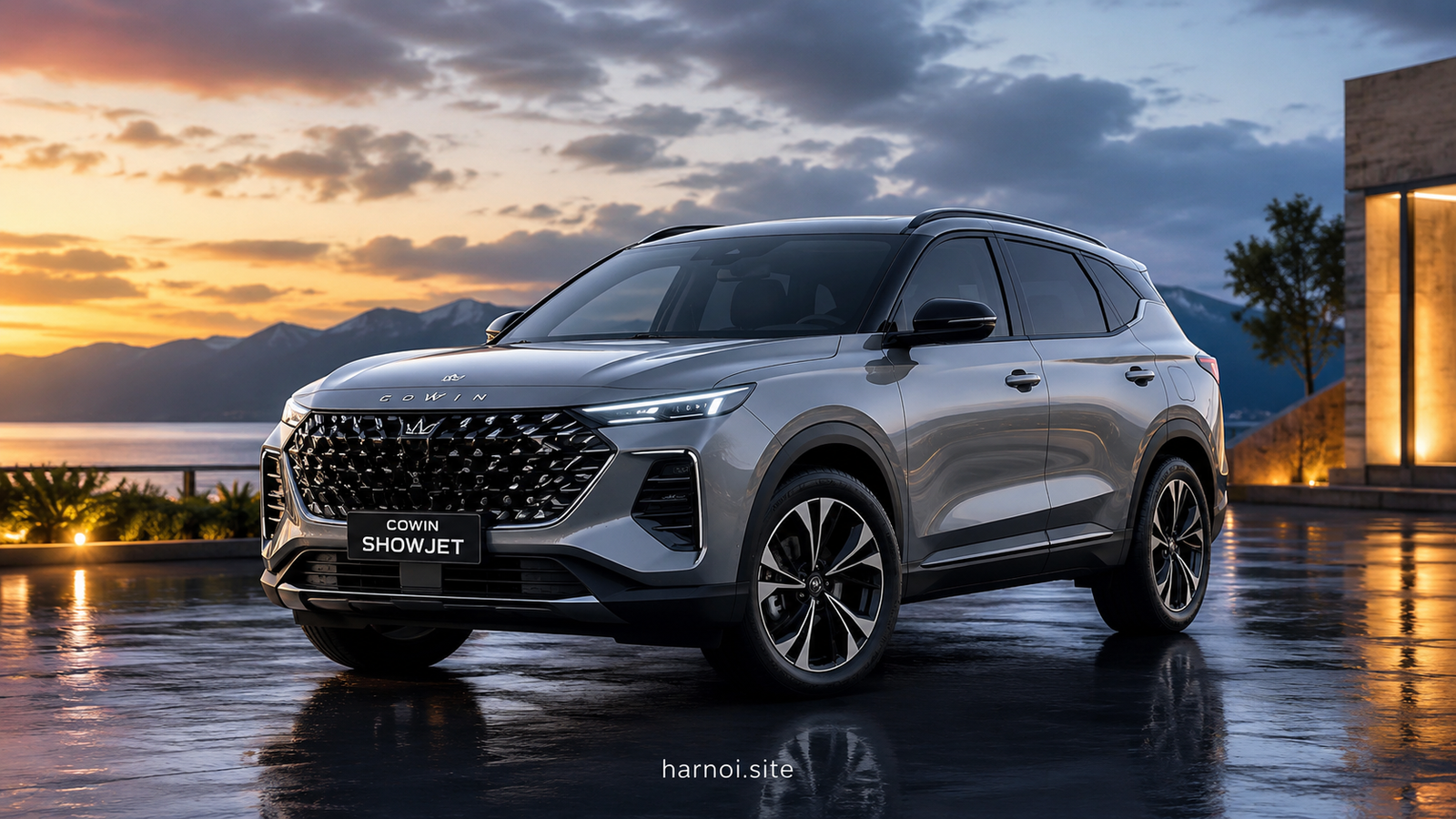
A note before we start: the Showjet is a Chinese-market subcompact crossover, and information on it in English is limited compared to mainstream global models. This overview pulls together what’s publicly documented — official specs, launch details, and market history — while being upfront about where independent, long-term ownership data (like reliability track records) simply isn’t available yet.
Introduction to Cowin Showjet
The Cowin Showjet is a subcompact crossover SUV that was <cite index=”2-1″>produced by the Chinese manufacturer Cowin Auto, a subsidiary of Chery, sharing its platform with the earlier Chery Tiggo 5x and carrying styling input from Pininfarina</cite>. It was built as an affordable, style-forward entry point into Cowin’s SUV lineup, aimed squarely at young, budget-conscious buyers in China’s smaller cities.
Today the car is better known internationally as the Kaiyi Showjet, following a corporate rebrand (more on that below). If you see it referred to by either name, it’s the same vehicle lineage.
History and Background
The Showjet’s story is tied closely to the history of its parent brand:
- Origins of the “Cowin” name: The name dates back to 2003, originally used for a facelifted version of the Chery Fulwin. <cite index=”8-2″>Cowin Auto was established as a standalone subsidiary of Chery in 2014, aimed at developing a new niche in China’s car market by targeting young buyers in medium and small towns with low prices.</cite>
- Corporate restructuring: <cite index=”8-3″>In 2018, part of Cowin was sold to the city of Yibin, with Yibin’s investment vehicles taking a combined 51% stake while Chery retained 49%, in a deal valuing the company at roughly RMB 5 billion (about $800 million). The headquarters moved to Yibin, Sichuan, and a new production plant there began building the X5 in January 2019.</cite>
- Showjet’s debut: <cite index=”9-1″>The vehicle, internally developed under the code FX11, was officially named “Showjet” on December 17, 2019, with production set for Cowin Auto’s smart plant in Yibin.</cite> <cite index=”5-1″>It launched with a starting price of just CNY 53,900 (about USD 7,622), designed by Lowie Vermeersch, the former chief designer at Pininfarina.</cite>
- Rebrand to Kaiyi: <cite index=”8-1″>In July 2022, Cowin Auto rebranded as Kaiyi Auto, adopting a more Chinese-sounding name along with a new design language across its model range.</cite> The Showjet continued under the Kaiyi badge, though “Cowin Showjet” remains widely used, especially in export markets and older listings.
- International reach: <cite index=”1-1″>A restyled Showjet Pro underwent a redesign in February 2024, gaining a new front fascia, reshaped bumper, and an updated interior with a new multimedia screen.</cite> The car has also found its way to a handful of overseas markets — for example, <cite index=”2-1″>an Italian importer, Eurasia Motors, began selling a rebadged version in September 2022 under a new brand called EMC, renamed the “EMC Wave 3,” locally converted to run on LPG in Piedmont.</cite>
Exterior Design
The Showjet was built to look sportier and more premium than its price tag suggests, which was central to its “budget but stylish” positioning.
- <cite index=”10-1″>The front end comes in two grille styles — a “W”-shaped grille and a “Gypsophila” (baby’s breath) patterned grille — giving buyers some visual choice within the lineup.</cite>
- <cite index=”10-1″>Color options span five solid body colors (white, red, blue, gray, and blue-toned variants) plus two-tone combinations like black-and-red, black-and-white, and black-and-blue.</cite>
- <cite index=”10-1″>Wheel designs include five-spoke and blade-aluminum styles across multiple sizes.</cite>
- <cite index=”10-1″>A hidden pillar treatment along the side creates a “floating roof” visual effect, a popular styling trick on crossovers in this segment.</cite>
- The Showjet Pro facelift went further, adding <cite index=”1-1″>a lower front air intake, a reshaped bumper, and distinctive teardrop-shaped bezels beneath the headlights.</cite>
Interior Features and Comfort
Inside, the Showjet leans on screen real estate and connectivity to punch above its price class:
- <cite index=”10-1″>Both the central touchscreen and the digital instrument cluster use 10.25-inch high-resolution displays with dual-screen linkage.</cite>
- <cite index=”10-1″>The infotainment system supports 1080p video playback, navigation projection, multimedia streaming, and multiple UI themes.</cite>
- <cite index=”10-1″>Interior color schemes include a pure black cabin and a black-and-red option with contrast stitching.</cite>
- On the Showjet Pro, standard comfort and convenience kit expanded to include <cite index=”29-1″>keyless entry, one-touch start, electric air conditioning, dual USB ports, and a dual-spoke multifunction steering wheel, along with wireless phone charging and in-car Wi-Fi.</cite>
Engine Specifications
The Showjet has been offered with a small but evolving set of powertrains over its lifespan:
- Base Showjet: <cite index=”2-1″>A 1.5-litre naturally aspirated inline-4 producing 116 PS (85 kW / 114 hp) and 143 N⋅m of torque.</cite>
- Showjet Pro: <cite index=”2-1″>A turbocharged 1.5-litre inline-4 (SQRE4T15 engine), producing 115 kW (154 hp / 156 PS).</cite>
- Newer Pro trims: More recent listings show turbo outputs stretching further, with variants advertised at <cite index=”6-1″>1.5T engines rated around 150 PS and 160 PS, still delivering 143 N⋅m of torque.</cite>
- Showjet Pro EV: The fully electric variant uses <cite index=”4-1″>a permanent-magnet synchronous motor rated at 120 kW (about 163 hp) with 280 N⋅m of peak torque, paired with a 53.6 kWh CATL/”Ningde era” lithium-iron-phosphate battery.</cite>
Performance and Driving Experience
Because this is a budget crossover built for city and semi-urban use rather than outright pace, official performance benchmarks are modest and sparsely published. The clearest figure available is for the EV: <cite index=”15-1″>the Showjet Pro EV can accelerate from a standstill to 50 km/h in about 3.77 seconds</cite>, which is brisk in city-driving terms thanks to the instant torque typical of electric motors. For the petrol versions, the naturally aspirated 1.5L is tuned for smooth, unhurried driving, while the turbocharged 1.5T in Pro trims adds noticeably more usable mid-range power for highway merging and overtaking — a common upgrade path buyers take when they want more than the base engine offers.
Fuel Efficiency
Cowin/Kaiyi has not published widely-cited independent fuel economy figures for international audiences, which is typical for a car sold mainly in China’s domestic market. As a general reference point, naturally aspirated 1.5L engines in this power and weight class typically return figures in the region of 6.5–7.5 L/100km (city/highway blended) under Chinese testing cycles, while the turbocharged variant would trade a bit of efficiency for its extra power. The EV’s range is better documented: <cite index=”4-1″>it has an NEDC-rated range of about 401 kilometers per charge, with 30%–80% DC fast charging support.</cite>
Transmission Options
The Showjet has offered a fairly wide transmission spread for a budget model:
- <cite index=”2-1″>A 5-speed manual gearbox or a CVT on the base 1.5L engine.</cite>
- <cite index=”29-1″>The Showjet Pro expanded this to three powertrain/transmission combinations: 1.5L with 5-speed manual, 1.5L with CVT, and 1.5T (turbo) with CVT.</cite>
- The EV variant, as with most electric vehicles, uses a single-speed reduction gear rather than a traditional multi-speed transmission.
Safety Features
Documented safety equipment on newer Showjet Pro trims includes a reasonably generous list for the price segment:
- <cite index=”6-1″>360-degree camera, anti-lock braking (ABS), Level 2 assisted driving, electronic brakeforce distribution (EBD/CBC), and electronic stability program (ESP/DSC).</cite>
- <cite index=”6-1″>Occupant-sensing airbags, traction/anti-slip control (TCS/ASR), and adaptive cruise control on higher trims.</cite>
- The EV variant adds <cite index=”4-1″>automatic parking, a 360-degree panoramic camera system, and lane departure warning.</cite>
As with performance and reliability data, independent crash-test ratings (Euro NCAP, C-NCAP, etc.) for the Showjet specifically aren’t widely published in English, so treat safety claims as manufacturer-stated equipment rather than independently verified crash performance.
Technology and Infotainment
The Showjet’s tech package is arguably where it tries hardest to stand out for its price point:
- <cite index=”29-1″>A built-in voice-assistant system (iFLYTEK-powered) that can be woken with a spoken command, plus phone-mirroring/mapping projection.</cite>
- <cite index=”29-1″>A companion smartphone app (“Kaiyi Zhixing”) that allows remote control of certain vehicle functions.</cite>
- <cite index=”4-1″>Voice control, a “phone butler” contact/call management feature, and one-button start round out the EV’s tech suite.</cite>
Dimensions and Cargo Space
<cite index=”10-1″>The Cowin Showjet measures 4,400mm in length, 1,831mm in width, and 1,653mm in height, riding on a 2,632mm wheelbase.</cite> These dimensions place it firmly in the subcompact crossover class — comparable in footprint to cars like the Honda HR-V or Renault Kiger — with enough wheelbase to offer reasonable rear legroom for a car this size, though official cargo volume figures aren’t widely published in English-language sources.
Available Variants
Over its production life, the Showjet lineup has included:
- Showjet (base/original) — 1.5L NA petrol, 5MT or CVT
- Showjet Pro — restyled model with 1.5L NA or 1.5T turbo, offered with 5MT or CVT; later received a 2024 facelift
- Showjet Pro EV — fully electric variant, launched for sale in three trims: <cite index=”4-1″>a “Yuexiang” version, a comfort version, and an exclusive version</cite>, priced at launch around <cite index=”4-1″>13.19–15.19 million yuan (note: this figure as reported converts to roughly 131,900–151,900 CNY when read as the more plausible ten-thousand-yuan unit typically used in Chinese pricing)</cite>
Pros and Cons
Pros
- Bold, distinctive styling for the price bracket, with input from a well-regarded ex-Pininfarina designer
- Generous screen technology (dual 10.25″ displays) rarely seen at this price point when new
- Turbocharged Pro variant offers a meaningful step up in power over typical budget-crossover rivals
- EV variant offers a genuinely competitive range (~401km NEDC) for its battery size
- Wide transmission choice (manual, CVT) across trims
Cons
- Very limited availability outside China and a small number of export/reseller markets — parts and dealer support elsewhere are inconsistent
- Little independent English-language testing, reviews, or long-term reliability reporting
- No widely published crash-test ratings from recognized international bodies
- Fuel economy and real-world performance figures are not well documented for global audiences
- Resale value and brand recognition are weak outside China, given the brand’s young age and 2022 rebrand
Common Problems and Reliability
This is the area where honesty matters most: there is no substantial body of independent, long-term reliability data on the Showjet available in English. It’s a relatively young nameplate (launched in 2020), sold predominantly in China with small-volume exports to markets like Italy, Russia, and Iran, and it hasn’t been through the kind of large-scale, multi-year ownership surveys (J.D. Power-style studies, owner forums with years of history, etc.) that give a clear reliability picture for more globally distributed cars. If you’re considering one, it’s worth treating any claims of “known issues” you find online with caution unless they’re backed by a documented source, and instead leaning on a pre-purchase inspection and a look at Chery’s broader mechanical reputation (since the Showjet shares its platform with the well-established Chery Tiggo 5x).
Maintenance and Service Costs
Similarly, there’s no reliable published data on routine maintenance or service costs for the Showjet in most markets outside China. As a general rule for cars sharing this platform and engine family, expect costs broadly in line with other Chery-group vehicles: parts and labor tend to be cheaper than Japanese or Korean equivalents in China itself, but this can flip in export markets where the car isn’t officially distributed and everything has to be sourced through independent importers.
Spare Parts Availability
Because the Showjet is not sold through an official dealer network in most countries, parts availability outside China (and the handful of markets with a local importer, such as Iran or Italy) is a genuine practical concern. Buyers in markets without an official Kaiyi/Cowin presence should expect to rely on aftermarket suppliers, generic Chery-group parts, or imported components — which can mean longer wait times and higher costs for anything beyond routine consumables.
Price and Value for Money
Pricing has moved over the years as the lineup evolved:
- Original Showjet launch price: <cite index=”5-1″>CNY 53,900 (about USD 7,622) at debut in 2020.</cite>
- Showjet Pro pre-sale range: <cite index=”19-1″>CNY 77,900–95,900, with an early-bird pre-sale range of CNY 74,900–92,900.</cite>
- Showjet Pro EV: launched at roughly <cite index=”4-1″>131,900–151,900 yuan across its three trims.</cite>
For what it offers on paper — screen tech, turbo power options, and distinctive styling — the Showjet undercuts many rivals in its home market. Its value proposition weakens outside China, though, once import costs, lack of warranty support, and parts sourcing are factored in.
Who Should Buy the Cowin Showjet?
The Showjet makes the most sense for:
- Buyers in China (or markets with an established local importer, like Iran or Russia) who want a stylish, tech-loaded, budget-friendly crossover for city and suburban use
- First-time car buyers on a tight budget who prioritize screen tech and looks over brand pedigree
- EV shoppers who want a compact crossover with a genuinely usable ~400km range at a lower price than more established EV brands
It’s a harder recommendation for buyers in markets without official distribution, where the risks around parts, service, and resale value are much higher, and where better-supported alternatives from Chery’s other brands or wider Chinese exporters (MG, Haval, Changan) may offer more peace of mind.
Comparison with Similar Cars
<cite index=”3-1″>Direct competitors named for the Showjet in its home market include the Baojun 510, Haval M6, Geely Vision X6, Changan CS35 Plus, and Baojun RS-3.</cite> Broadly:
- Vs. Haval M6: The M6 benefits from Haval’s stronger export network and more established reputation, at a similar price point.
- Vs. Changan CS35 Plus: The CS35 Plus has a wider international presence and more consistent parts support, though the Showjet arguably offers a flashier interior for the money.
- Vs. Baojun 510/RS-3: Baojun (a GM/Wuling-linked brand) has stronger domestic sales volume and a longer track record in the same budget-crossover space.
Frequently Asked Questions (FAQs)
Is the Cowin Showjet the same as the Kaiyi Showjet? Yes — Cowin Auto rebranded to Kaiyi Auto in 2022, so “Cowin Showjet” and “Kaiyi Showjet” refer to the same model lineage, just under different brand names depending on when and where it was marketed.
Is the Showjet an SUV or a crossover? It’s marketed as a subcompact crossover SUV, sitting below the larger Kaiyi/Cowin X3 in the brand’s lineup.
Does the Showjet come as an EV? Yes, the Showjet Pro EV is a fully electric version with an NEDC-rated range of about 401km.
Is the Showjet sold in Pakistan or other South Asian markets? There’s no evidence of an official Kaiyi/Cowin distribution network for the Showjet in Pakistan based on currently available information; it’s primarily a China-domestic model with export presence in select markets like Iran, Russia, and Italy.
What engines does the Showjet offer? A 1.5L naturally aspirated engine on base trims, and a 1.5-litre turbocharged engine on Pro trims, alongside a fully electric powertrain on the Pro EV.
Final Verdict
The Cowin/Kaiyi Showjet is a good example of what modern budget-focused Chinese automakers do well: strong screen technology, distinctive design, and competitive on-paper pricing, all wrapped around a proven mechanical platform borrowed from the Chery Tiggo 5x. Where it comes up short for international buyers is everything that happens after the sale — reliability data, dealer support, and parts availability are all thin outside China and a small set of export markets. If you’re shopping in a region where Kaiyi has an official presence, it’s a genuinely interesting value option. Anywhere else, it’s a car best approached with your eyes open about the ownership risks that come with a young, low-volume nameplate.