Introduction to the Leapmotor T03
The Leapmotor T03 is a tiny, budget-focused electric city car from Leapmotor, a Chinese EV maker that has partnered with automotive giant Stellantis to bring its cars to Europe and beyond. Measuring just 3.6 metres long, the T03 is aimed squarely at buyers who want zero-emission motoring without the high price tag usually attached to it. It undercuts nearly every other EV on sale except the Dacia Spring, while offering a longer range, more power, and a far longer standard equipment list than that rival.
Since Stellantis took a stake in Leapmotor, the T03 sold in Europe has been built at a Stellantis-run plant in Tychy, Poland, giving the car a level of manufacturing pedigree and dealer-network support that many Chinese newcomers lack. In China, the T03 has effectively been phased out and replaced by newer models such as the A05 and A10, but it remains on sale as Leapmotor’s entry-level model in Europe and other export markets.
Key Specifications at a Glance
- Length: 3,620mm
- Width: 1,577mm
- Battery: 37.3kWh lithium-ion
- Power: 95hp (94–95bhp) and around 158Nm of torque
- Drive layout: Single motor, front-wheel drive
- 0–62mph: 12.7 seconds
- Top speed: 81mph
- Official range: 165 miles (WLTP combined)
- Max DC charging: 48kW
- AC charging: 6.6kW
- Wheels: 15-inch alloys on 13-inch rims (varies by market)
- Boot space: 210 litres
- Warranty: 4 years
- Starting price (UK): £15,995
Exterior Design
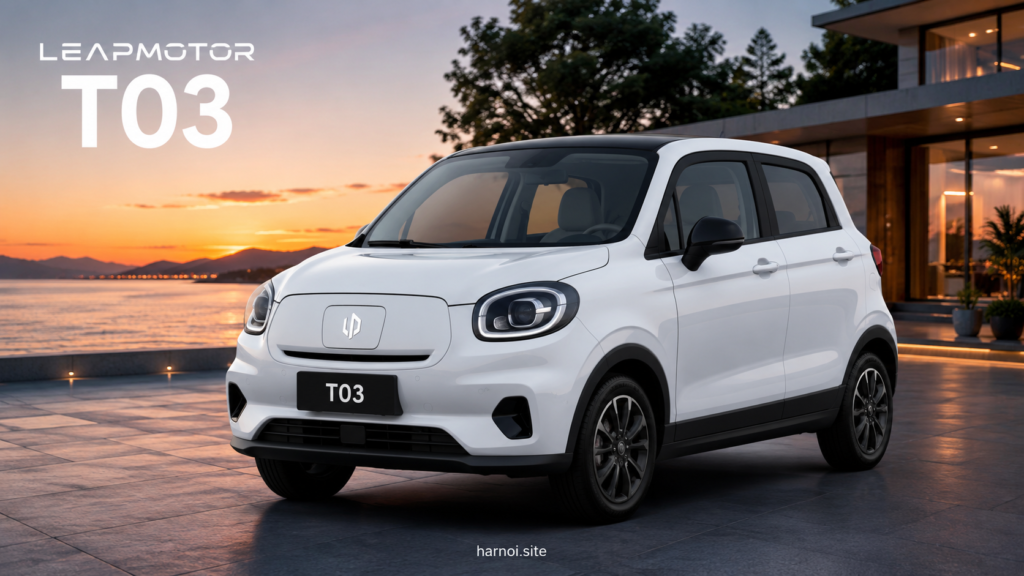
The T03’s styling is soft, rounded, and slightly cartoonish, with round headlights that many reviewers liken to a friendly face — some have compared its look to a Fiat Panda, others to a shrunken kei car. Its tall, narrow body helps maximise interior space despite the compact footprint, and the car sits on small wheels that emphasise its city-car proportions. A panoramic glass sunroof is standard, which is a rare touch at this price point, though the small rear window lacks a wiper, something owners in wetter climates may notice.
The boxy shape gives the driver a commanding view over the short bonnet, which makes the T03 easy to place in traffic and tight parking spaces, even if thick windscreen pillars can occasionally obstruct the view at junctions.
Interior Design and Cabin Quality
Inside, the T03 goes for a “grown-up car” feel with dual screens: an 8-inch digital driver’s display and a 10.1-inch central touchscreen. Build quality is generally regarded as solid for the price, with soft-touch elements and fabric-trimmed armrests that lift the cabin slightly above pure budget territory. That said, the colour scheme leans heavily on dark greys and black, which some reviewers find a little drab compared with more characterful rivals like the Renault 5.
Physical buttons are scarce — even the volume control is handled through the touchscreen — and this is one of the T03’s most consistently criticised traits. The infotainment software is not considered particularly slick or responsive, and there’s no Apple CarPlay or Android Auto support, a notable omission at any price point in 2026.
Battery, Motor and Driving Range
The T03 uses a 37.3kWh battery pack (an increase from the original Chinese-market car’s 36.5kWh unit) paired with a single front-mounted electric motor producing around 95hp and roughly 158Nm of torque. The official WLTP range sits at 165 miles, comfortably ahead of the Dacia Spring’s 140 miles, though behind larger, pricier rivals like the Renault 5 or Hyundai Inster.
In real-world motorway and town testing, reviewers have recorded efficiency figures ranging from about 3.4 to 4.4 miles per kWh, translating to realistic mixed-driving range in the 130–150 mile bracket rather than the full official figure — a fairly typical shortfall for EVs used outside of pure urban, low-speed conditions.
Performance and Driving Experience
With 95hp on tap, the T03 feels noticeably brisker than the Dacia Spring, especially when accelerating up to motorway speeds, and its 12.7-second 0–62mph time beats the Spring’s figures comfortably. Grip has impressed several testers thanks to the fitment of proper Continental tyres rather than the budget rubber often found on cheap Chinese EVs.
Steering is light and easy at low speeds, ideal for tight city manoeuvring, though it becomes vague and a little wandering at higher motorway speeds. The regenerative braking system is mild rather than aggressive, meaning drivers will still need to rely on the brake pedal in most everyday situations. Overall, the T03 is regarded as a competent, if unexciting, drive — polished around town but not particularly engaging or sharp compared with something like the Renault 5.
Charging Options and Charging Time
Charging is one area where the T03’s small battery works in its favour, even if peak charge rates are modest by 2026 EV standards.
- AC home charging (6.6kW): roughly 6 hours for a full charge
- DC rapid charging (up to 48kW): around 36 minutes for a 30–80% top-up, or approximately 53 minutes for a 10–80% charge
These figures are broadly on par with the Fiat 500e and ahead of the Dacia Spring’s slower charging ceiling, though they lag well behind more expensive rivals with larger, faster-charging batteries.
Technology and Infotainment Features
Standard tech includes the 10.1-inch touchscreen, 8-inch digital instrument cluster, a multifunction steering wheel, keyless entry, and a rear-view camera with rear parking sensors. Adaptive cruise control is also standard — a genuine surprise at this price — alongside lane-keeping assistance, blind-spot monitoring, driver drowsiness detection, and automatic emergency braking.
The catch is execution. Multiple reviewers describe the driver-assistance systems as overly intrusive, with frequent audible warnings triggered by minor lane deviations, looking down briefly, or even yawning and talking to passengers. Turning these systems off requires navigating touchscreen menus, which itself can trigger a distraction warning — a frustrating loop that has become one of the most widely repeated criticisms of the car. The lack of Apple CarPlay and Android Auto compounds the infotainment frustrations for many buyers.
Safety Features
Every T03 comes with six airbags as standard, along with autonomous emergency braking, lane-keep assist, lane-departure warning, traffic sign recognition, blind-spot warning, driver attention monitoring, and adaptive cruise control — a genuinely generous list for a car at this price. Leapmotor states that around 68% of the T03’s body structure uses high-strength steel, and the battery pack itself forms part of the car’s structural design, as is common on modern EVs.
At the time of writing, the T03 has not been independently crash-tested by Euro NCAP, so there is no official star rating to point to. This is a genuine gap compared with rivals like the Dacia Spring (which has been tested, albeit with a poor result) and Leapmotor’s own larger B10 SUV, which achieved a 5-star Euro NCAP rating. Leapmotor’s European leadership has even suggested it might be willing to accept a lower NCAP score in exchange for less intrusive driver-assistance software — a stance that may reassure drivers frustrated by constant alerts, but doesn’t resolve the lack of independent test data for this specific model.
Comfort and Practicality
Given its size, the T03 offers a genuinely surprising amount of passenger space. Because the front seats don’t slide back very far, rear legroom is generous for a car this small, and four adults around six feet tall can fit without excessive discomfort, though headroom in the back is merely adequate for taller passengers.
Up front, storage is reasonably good, with a decent glovebox, sizeable door bins, a phone cutout with nearby charging sockets, and a single cupholder. The driving position suits shorter and average-height drivers better than tall ones, since the steering wheel adjusts only up and down (not in and out), and some testers found the front seats didn’t move back far enough for 6ft+ drivers to get fully comfortable.
Dimensions and Cargo Space
At 3,620mm long and 1,577mm wide, the T03 is shorter than key rivals such as the Dacia Spring and Hyundai Inster, despite being both wider and taller — a combination that actually helps interior practicality. Boot space is a relatively tight 210 litres, notably smaller than the Dacia Spring’s cargo area, and the boot opening itself is narrow and set fairly high, making it awkward to load bulkier items despite the decent overall volume of usable interior space.
Real-World Driving Experience
Independent test drives paint the T03 as a car that does its best work in town: refined enough at low speeds, easy to place, and quick enough off the line to keep up with city traffic comfortably. On faster roads, wind noise becomes noticeable, road noise is only moderately well controlled, and motor whine is audible at low speeds around town. In head-to-head testing against the Dacia Spring, several UK outlets have rated the T03 as the more well-rounded car overall, citing better refinement, a longer real-world range, and a much longer equipment list, even if it lacks any real driving character or excitement.
Pros and Cons
Pros:
- One of the cheapest EVs on sale, with a long list of standard equipment
- More power and a longer official range than its closest rival, the Dacia Spring
- Surprisingly spacious cabin for such a compact car
- Adaptive cruise control, six airbags, and a wide driver-assistance suite as standard
- Decent build quality and interior materials for the price
- Backed by Stellantis’s dealer and service network
Cons:
- No Apple CarPlay or Android Auto
- Overly sensitive, frequently intrusive driver-assistance warnings
- Fiddly touchscreen-dependent controls with very few physical buttons
- Small, awkwardly shaped boot
- Not yet independently crash-tested by Euro NCAP
- Lacks the design character and driving fun of rivals like the Renault 5
Leapmotor T03 vs Competitors
The T03’s closest rival by far is the Dacia Spring, which is around £1,000 cheaper but offers less power, a shorter range, slower charging, and considerably less standard equipment — the T03 has generally come out ahead in direct comparisons for exactly these reasons. The Hyundai Inster and Renault 5 E-Tech sit a step above on price but offer more range, sharper handling, and considerably more design flair and driving enjoyment. The Citroën ë-C3, developed alongside the T03 under the Stellantis umbrella, and the Fiat 500e both cost noticeably more but bring stronger badge appeal and, in the 500e’s case, a more premium feel. For buyers who want the cheapest possible way into an EV with a genuinely usable range and equipment list, the T03 remains one of the strongest value propositions on the market.
Maintenance and Running Costs
As an EV, the T03’s running costs are low by nature — no fuel, minimal servicing requirements, and low road tax in most markets, especially in countries offering EV incentives. Leapmotor and Stellantis have emphasised affordability of ownership, citing high parts availability (around 95% in Europe and the UK) and shared service infrastructure through Stellantis’s established dealer network, which should help keep repair costs and wait times down compared with a standalone Chinese import brand. The T03 comes with a 4-year warranty, shorter than some rivals like the Dacia Spring’s 3-year (T03 exceeds this) but behind cars like the BYD Dolphin Surf’s longer cover.
Insurance group data has been slow to materialise in some markets, so it’s worth getting a personalised quote before buying, as this can vary considerably by region and insurer experience with newer brands.
Common Problems and Reliability
Because the T03 is still a relatively new arrival in most markets outside China, there isn’t yet a substantial body of long-term reliability data. The most consistently reported issue isn’t mechanical but software-related: overly sensitive driver-assistance systems that misread road signs or trigger excessive warnings, which Leapmotor has said it is working to refine through regular software updates. Some test cars have also shown minor build issues, such as front tyres brushing against wheel arch liners under full steering lock — though it’s unclear how widespread this is across production cars. As with any new brand, prospective buyers should watch for updated reliability data and recall notices as more T03s accumulate mileage on the road.
Who Should Buy the Leapmotor T03?
The T03 makes most sense for city-dwellers and short-commute drivers who want to switch to electric motoring on the smallest possible budget, without giving up items like adaptive cruise control, a sunroof, and a full driver-assistance suite. It suits buyers who prioritise value and practicality over driving excitement or infotainment polish, and who are comfortable with a car that hasn’t yet built up a long safety-testing or reliability track record. Those who frequently drive longer distances, want smartphone mirroring, or are sensitive to intrusive safety alerts may be better served by a slightly pricier rival such as the Hyundai Inster or Renault 5.
Frequently Asked Questions (FAQ)
Is the Leapmotor T03 a good first EV? It’s a strong option for anyone wanting an affordable, low-risk way to try electric driving, particularly for city and short-trip use, though the frustrating driver-assistance systems can take some getting used to.
Does the Leapmotor T03 have Apple CarPlay or Android Auto? No — this remains one of its most commonly cited drawbacks.
What is the real-world range of the Leapmotor T03? Official WLTP range is 165 miles, but real-world mixed driving typically yields somewhere between 130 and 150 miles depending on conditions and driving style.
Has the Leapmotor T03 been crash tested? As of this review, it has not been independently tested by Euro NCAP, though it comes with six airbags and a wide range of standard driver-assistance features.
How does the T03 compare to the Dacia Spring? The T03 generally offers more power, a longer range, faster charging, and a longer equipment list, for a small premium over the Spring’s asking price.
Final Verdict
The Leapmotor T03 succeeds at its core mission: making electric motoring genuinely affordable without stripping out the equipment buyers actually want. It undercuts almost every EV on the market, out-specs its nearest rival, and offers a cabin that’s more spacious and better equipped than its size and price would suggest. Where it stumbles is in refinement of execution — an intrusive, touchscreen-dependent tech suite, the absence of smartphone mirroring, and the lack of independent crash-test data hold it back from being an outright recommendation for every buyer. For those focused purely on affordable, practical, city-based electric motoring, though, the T03 remains one of the most compelling budget EVs available today.