Introduction to Micro Microlino
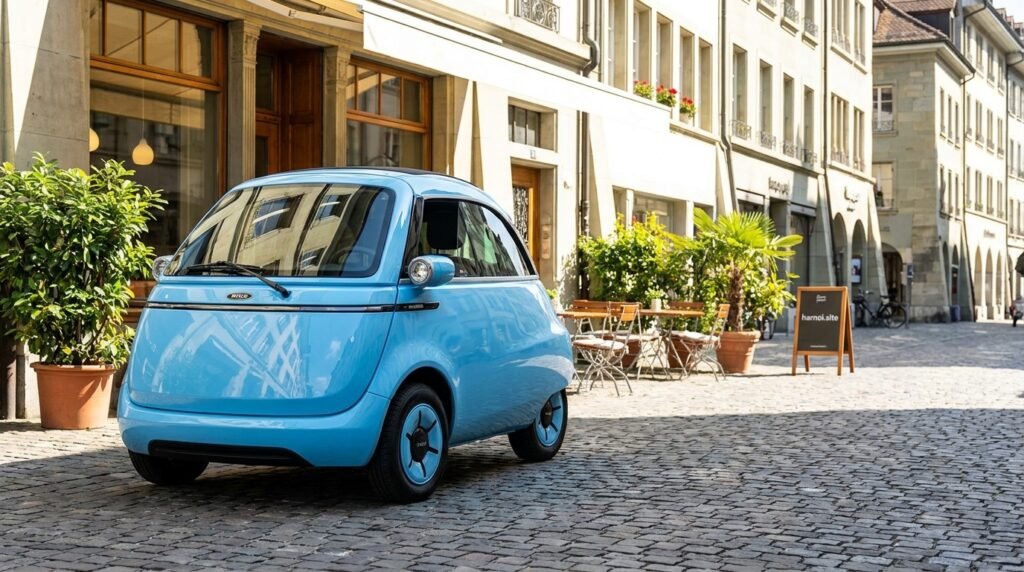
Most electric cars chase range, horsepower, and screen size. The Microlino chases something else entirely: charm. Built by the Swiss company Micro Mobility Systems — the same people behind the folding kick scooter — the Microlino is a tiny, two-seat electric “bubble car” that looks like it drove straight out of the 1950s. It has a single front-opening door, no B-pillars, tiny wheels, and a shape that turns heads wherever it goes. In a world of look-alike crossovers, that alone makes it worth a closer look.
What is the Micro Microlino?
The Microlino is a battery-electric quadricycle, not a “car” in the strict legal sense. In Europe it’s classified as either an L6e (light quadricycle) or L7e (heavy quadricycle), depending on the version, which means it sits in a regulatory category between a moped and a full car. It seats two people side by side, has a top speed of up to 90 km/h (56 mph) in its fastest form, and is aimed squarely at short urban trips rather than motorway journeys.
History of the Micro Microlino
The story starts in 2016, when Micro unveiled the Microlino concept at the Geneva Motor Show as a fun styling exercise. The public reaction was immediate — <cite index=”6-1″>the company received more than 500 reservations within two days</cite> of the reveal, which pushed Micro to turn the concept into a real production car. Development wasn’t smooth: an early manufacturing partnership with the Italian firm Tazzari fell apart, and a legal dispute followed after a rival, Artega, tried to launch a near-identical “Karolino.” Micro won that fight and eventually built its own factory in Turin, Italy, where <cite index=”6-1″>series production of the Microlino 2.0 began in 2022</cite>. Since then, the lineup has grown to include the stripped-back Microlino Lite (2024) and the open-top Microlino Spiaggina, a beach-cruiser-style special edition.
Micro Microlino Design and Exterior
Visually, the Microlino borrows heavily from the BMW Isetta of the 1950s — round headlights perched on the front fenders, a bulbous body, and a single door that opens outward at the front of the car, hinged like a refrigerator door. Unlike the original Isetta, though, the steering column stays fixed to the floor rather than swinging with the door, and the Microlino uses two wheels at the rear instead of the Isetta’s single rear wheel. The car is genuinely tiny — roughly 2.5 metres long and 1.5 metres wide, about the footprint of a first-generation Smart ForTwo — and it sits on small 13-inch wheels. Details like mirror-mounted headlights, a hidden door-release button, and slim LED light bars give it a distinctive night-time signature.
Interior Features and Cabin
Step through that front door and you’re greeted by a simple bench seat built for two adults of average size, with enough seat-base adjustability to suit taller drivers. The cabin philosophy is minimalist: a dual digital display, a heater, USB-C charging ports, a small under-seat storage compartment, and — depending on the trim — a sunroof, vegan leather steering wheel, and Sport mode. There’s no glovebox-stuffed infotainment system or elaborate driver-assist screen here; the Microlino leans into simplicity rather than tech overload.
Battery Options and Range
The Microlino comes with a choice of three battery packs — <cite index=”1-1″>6, 10.5, or 14 kWh, offering a claimed range of up to roughly 56, 110, or 143 miles respectively</cite>. Real-world range tends to fall short of those WLTP-style figures, especially in cold weather or on faster roads, with owners and reviewers commonly reporting closer to 90–180 km (55–110 miles) depending on conditions and battery size.
Motor Performance and Top Speed
Every standard Microlino uses the same rear-mounted electric motor, <cite index=”6-1″>delivering 12.5 kW (about 17 hp) and driving the rear wheels</cite>. That’s enough for a top speed of <cite index=”1-1″>56 mph (90 km/h) and a 0–31 mph time of around 5.0 seconds</cite> in the full-fat version — brisk enough for city traffic, if not remotely quick by conventional car standards. The Microlino Lite is deliberately detuned, with a top speed capped at 45 km/h (28 mph) so it qualifies for the lighter L6e category, which can be driven on a moped-equivalent AM licence.
Charging Time and Charging Methods
There’s no rapid or DC fast-charging option on any Microlino — a deliberate choice given the small battery packs. Charging is done via a household three-pin plug or a Type 2 connector, and <cite index=”6-1″>a full charge takes roughly three to four hours depending on which battery is fitted</cite>. Micro’s reasoning is that most urban commuters drive relatively short daily distances, so a slow overnight or workplace charge is realistically all that’s needed.
Technical Specifications
- Length/width: approx. 2.5 m / 1.5 m
- Seating: 2, side-by-side
- Motor: rear-mounted, 12.5 kW (17 hp), rear-wheel drive
- Battery options: 6 kWh, 10.5 kWh, 14 kWh
- Range: up to ~56 / 110 / 143 miles depending on battery
- Top speed: 45 km/h (Lite) or 90 km/h (standard)
- 0–31 mph: approx. 5.0 seconds (standard version)
- Charging: household plug or Type 2, no fast charging, ~3–4 hours full charge
- Construction: steel-and-aluminium unibody with floor-mounted battery
- Wheels: 13-inch
Safety Features
Because it’s classified as a quadricycle rather than a passenger car, the Microlino isn’t required to meet the same crash-test standards as a conventional EV, and Euro NCAP doesn’t test vehicles in this category at all. That means no mandatory airbags and, on base models, no ABS. That said, Micro highlights its steel-and-aluminium unibody as a genuine safety advantage over lighter rivals — <cite index=”1-1″>it’s said to be considerably safer in a crash than open-sided competitors like the Renault Twizy or Citroën Ami</cite>. Still, buyers should go in with realistic expectations: a used mainstream EV will offer meaningfully more crash protection and driver-assist tech.
Driving Experience
Reviewers consistently describe the Microlino as more “proper car” than “glorified golf buggy.” The steering is unassisted, which takes a bit of muscle at parking speeds but <cite index=”1-1″>feels accurate and satisfying once moving</cite>. Around town, the instant torque of the electric motor makes it feel peppier than its modest power figure suggests, and testers have noted it’s <cite index=”1-1″>noticeably more responsive than the sluggish Citroën Ami</cite>. On the flip side, some reviewers have found handling slightly vague when cornering with the heavier, longer-range battery fitted, and the ride can be abrupt over speed bumps — not ideal for a car built for city streets full of them.
Price and Available Models
Pricing varies by market and configuration. In the UK, the Microlino Lite starts <cite index=”1-1″>from around £17,000, with the standard Microlino Edition starting around £18,000</cite>, and a well-equipped example with the largest battery and extras can climb past £20,000. In continental Europe, list prices start from roughly €17,900–CHF 17,990 depending on trim, with the open-top Spiaggina positioned as a premium special edition. The lineup currently spans:
- Microlino Lite – L6e class, 45 km/h top speed, smallest battery, AM licence eligible
- Microlino (Edition/standard) – L7e class, 90 km/h top speed, choice of battery sizes
- Microlino Spiaggina – open-air, beach-cruiser-styled limited edition
Pros and Cons
Pros:
- Genuinely distinctive, head-turning retro design
- Fun, direct driving character for a small city vehicle
- Well-finished cabin for a quadricycle
- Multiple battery/range options to suit different budgets
- Tight turning circle and effortless parking
Cons:
- Expensive relative to its size and capability — pricing can exceed that of a full five-seat supermini
- No fast charging
- Limited safety equipment compared with a full passenger car
- Not suitable for motorway or long-distance driving
- Minimal storage space
Maintenance and Running Costs
With far fewer mechanical parts than a conventional car — Micro claims <cite index=”6-1″>roughly 50% fewer components than a typical automobile</cite> — running costs are generally low. There’s no engine oil, no transmission fluid, and a small battery that’s cheap to charge. Insurance and any applicable licensing costs will vary by country and by which quadricycle class the car falls into, and depreciation patterns are still being established given how new and niche the model is.
Is the Micro Microlino Worth Buying?
It depends entirely on what you need from a vehicle. As a second car for short urban hops, grocery runs, or a stylish way to beat parking headaches, the Microlino delivers something genuinely different and enjoyable. As a primary or only vehicle, its short range, lack of fast charging, and higher-than-expected price tag make it a harder sell — you could buy a larger, more practical, and better-equipped mainstream EV for similar or less money. The Microlino is best understood as a lifestyle purchase as much as a transport solution.
Micro Microlino vs Citroën Ami
The Citroën Ami is the Microlino’s closest philosophical rival, but the two take very different approaches. The Ami is deliberately utilitarian and inexpensive, built around a symmetrical body to cut production costs, with a modest 6 kW motor and a top speed capped at 45 km/h. The Microlino, by contrast, aims for a more finished, “proper car” feel, higher performance, and a higher price to match. Where the Ami majors on being cheap and functional, the Microlino majors on design, materials, and driving enjoyment — at a noticeably higher cost.
Micro Microlino vs Fiat Topolino
The Fiat Topolino is mechanically a rebadged Citroën Ami with retro Fiat styling, which puts it in a similar bracket to the Ami rather than the Microlino. <cite index=”16-1″>The Topolino uses an 8 hp (6 kW) motor with a 5.4 kWh usable battery, offering around 46–47 miles of range and a 28 mph top speed</cite> — figures well below the standard Microlino’s performance and range ceiling. The trade-off is price: the Topolino starts many thousands less than a Microlino, making it the more accessible choice for buyers who want the retro-microcar look without the Microlino’s premium positioning.
Best Features of the Micro Microlino
- Its unmistakable, Isetta-inspired retro styling
- A driving experience that feels closer to a real car than a quadricycle
- Genuine build quality and interior finish for the segment
- A relatively steel-and-aluminium unibody that adds structural reassurance
- Flexibility across battery sizes and licensing categories
Common Problems and Drawbacks
Owners and reviewers point to a few recurring gripes: no fast-charging capability, a firm ride that struggles with speed bumps, some vagueness in handling on the longer-range, heavier battery pack, and a price point that undercuts the argument for buying one over a cheap, more practical used EV or petrol supermini. The single front door, while characterful, also demands a bit of a learning curve to get in and out gracefully.
Frequently Asked Questions (FAQ)
Is the Microlino a real car? Legally, no — it’s classified as a quadricycle (L6e or L7e) in Europe, not a passenger car, though it’s built and drives much like one.
Do you need a special licence to drive it? The Microlino Lite can be driven on a moped-equivalent licence in many European countries because of its lower top speed and weight. The standard Microlino, with its higher top speed, typically requires a full driving licence.
Can it be fast-charged? No. All Microlino versions rely on standard household or Type 2 AC charging, taking roughly three to four hours for a full charge.
How many people does it seat? Two, side by side on a shared bench seat.
Is it available in the US? The Microlino has primarily been sold in European markets; availability outside Europe is limited and subject to change, so check with an authorized retailer for your region.
Final Verdict
The Microlino isn’t trying to be the most practical or the best-value electric car on sale — it’s trying to be the most memorable one in its class. Its retro design, unusual quadricycle status, and genuinely enjoyable low-speed driving manners set it apart from every other small EV on the road, including its closest rivals, the Citroën Ami and Fiat Topolino. If you want a city runabout that turns every parking spot into a photo opportunity and don’t mind paying a premium for the privilege, the Microlino is one of the most unique electric vehicles you can buy today.