Introduction
The Maxus D60 has quietly become one of SAIC’s best-selling crossovers across the Middle East and Southeast Asia, and the 2026 model year keeps the formula largely intact while sharpening a few edges. This guide walks through everything a shopper needs — design, engine, ride quality, tech, safety, pricing by region, and how it stacks up against rivals like the Chery Tiggo 7/8, Geely Okavango, and Honda CR-V.
Note: Maxus sells the D60 through independent regional distributors, so exact trim names, engine states of tune, and pricing differ by country. Figures below reflect the ranges reported across major markets (UAE, Saudi Arabia, Qatar, Philippines); always confirm final specs with your local dealer.
Overview of Maxus D60 2026
The D60 is a mid-size crossover SUV built on a unibody platform, offered in both 5-seat and 7-seat layouts depending on trim. It sits below the larger D90 in Maxus’s SUV lineup and shares underpinnings with the G50 MPV. The design lineage traces back to SAIC’s Tarantula concept SUV shown at the 2018 Beijing Auto Show, and the current-generation D60 (including the higher-spec “MAX” trim sold in some markets) is a facelifted, tech-updated version of that original.
Exterior Design
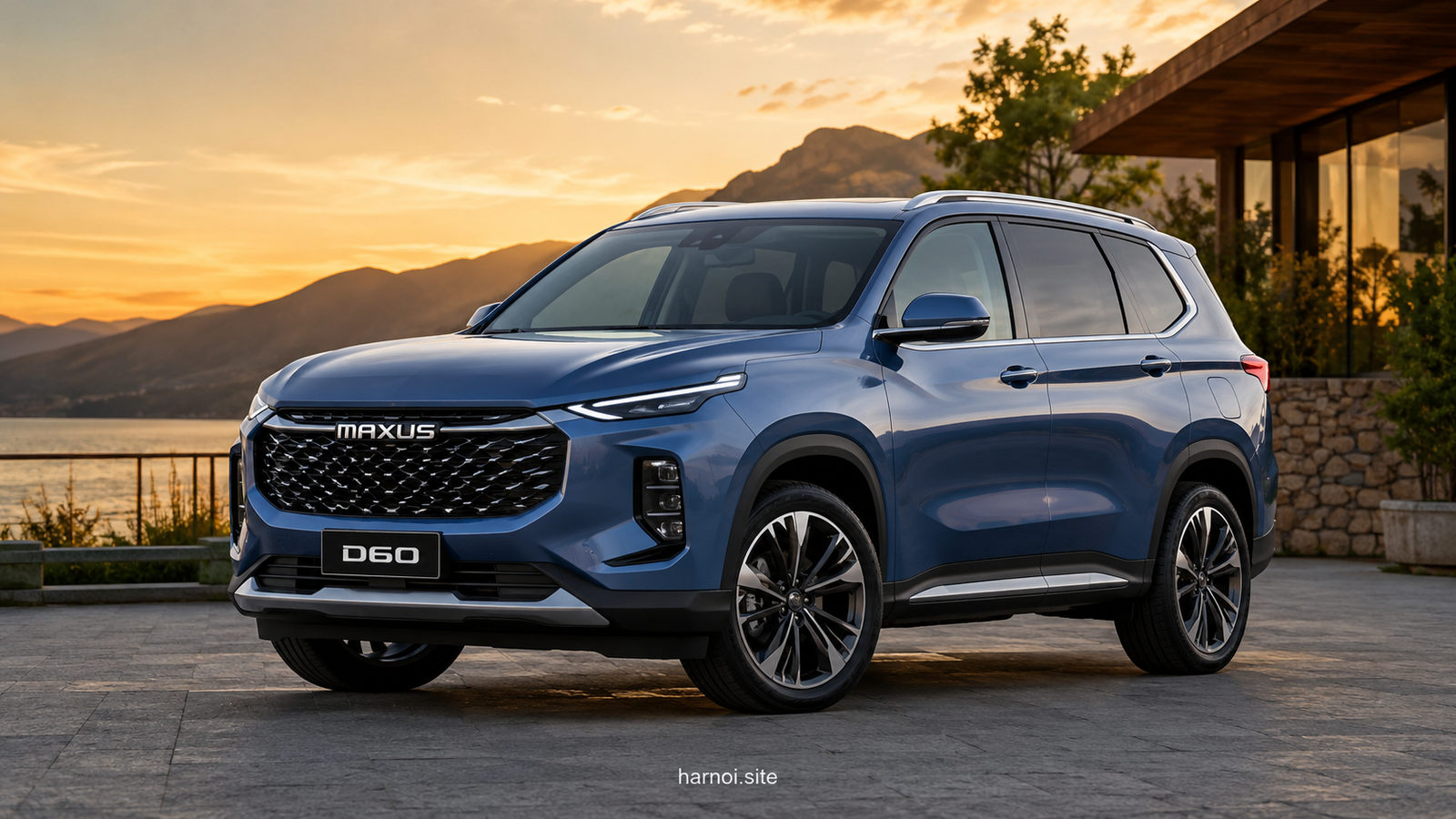
The D60’s front end is dominated by a large octagonal grille with a honeycomb or “cobweb” mesh pattern, flanked by swept-back headlamps — full LED matrix units on upper trims — and integrated fog lamps. Character lines run the length of the body, wide wheel arches give it a planted stance, and the rear is finished with a unified LED tail-light bar and dual (often faux) exhaust tips. Wheel sizes range from 17 to 18 inches depending on variant, and higher trims add a panoramic sunroof and roof rails.
Interior Design & Cabin Quality
Inside, the cabin leans on a dark theme with silver or piano-black accents, soft-touch panels above the center console, and a three-spoke, leather-wrapped multifunction steering wheel. Entry trims get fabric seats while Elite/MAX trims move to leather or PVC-leather upholstery with 6-way electric adjustment for the driver. The dashboard pairs a digital instrument cluster (up to 12.3 inches on top trims) with a floating touchscreen, giving the cabin a reasonably modern layout for the price point. Rear passengers get their own AC vents, and the D60 offers a deep center console, multiple cupholders, and a usable glovebox.
Engine Specifications
The D60 is powered by a 1.5-liter turbocharged inline-4 gasoline engine (some earlier and export markets also offered a 1.3-liter turbo). Depending on market tuning, output ranges from roughly 159 hp to 170 hp, with torque figures between 250 Nm and 285 Nm on the more recent MAX-spec engine. It’s a direct-injection, intercooled unit sending power exclusively to the front wheels — there is no AWD option.
Performance & Driving Experience
Owner feedback consistently points to a lively mid-range punch from the turbo engine, particularly useful for overtaking on highways, paired with a transmission that shifts smoothly enough for daily driving. It won’t feel like a performance SUV, but the turbo motor avoids the flat, sluggish feel common in naturally aspirated rivals in this segment. Around town the electric power steering is light, and the chassis — tuned in part with input from Britain’s MIRA testing facility — stays composed over broken pavement.
Fuel Economy (MPG / km/L)
Maxus quotes fuel economy in the range of 14.4 to 15.3 km/L (roughly 34–36 mpg US) for the 1.5-liter turbo, with a claimed range of up to 1,008 km on a full tank in the updated MAX variant. Real-world figures will run somewhat lower depending on load, driving style, and traffic conditions, as with most turbocharged small-displacement engines.
Transmission & Drivetrain
All D60 variants use a 7-speed dual-clutch transmission (DCT) — a wet-clutch unit on the updated engine, which helps with heat management and smoothness compared to older dry-clutch DCTs. Drive is sent to the front wheels only; there’s no manual gearbox or all-wheel-drive option in current-generation markets, which positions the D60 firmly as an urban/highway family SUV rather than an off-roader.
Ride Comfort & Handling
Suspension is a conventional MacPherson strut front and multi-link independent rear setup. Combined with 17–18 inch wheels and reasonably tall sidewalls, the ride leans toward comfort over sharpness — a sensible choice for a family SUV. Cabin noise insulation is generally praised by owners, and the AC system is described as strong enough for hot climates, an important consideration given the D60’s popularity in the Gulf.
Safety Features
Standard and available safety equipment includes:
- 4 to 6 airbags depending on trim (driver, front passenger, side)
- Electronic Stability Program (ESP/ESC), traction control, and Hill Hold Control (HHC)
- ABS with Electronic Brakeforce Distribution (EBA)
- ISOFIX child seat anchors
- Reversing camera and rear parking sensors (front sensors added on higher trims)
- Electronic parking brake with auto-hold
- Blind Spot Detection, Rear Cross-Traffic Alert, and Driver Attention Warning on upper trims
- A body structure using a mix of high-strength and ultra-high-strength steel, with Maxus citing ANCAP crash-test evaluation for the platform
This is a solid, if not class-leading, safety package — comparable to other Chinese mid-size crossovers, though it trails segment leaders like the Honda CR-V on standard advanced driver-assistance systems in base trims.
Infotainment & Technology
The D60 comes with an 8-inch touchscreen infotainment system with Bluetooth connectivity and a 6-speaker audio setup as standard. Higher trims add a larger digital instrument cluster, wireless phone charging, and additional connectivity features. It’s a functional, competent system rather than a class leader — buyers expecting Apple CarPlay/Android Auto or a larger central display should verify availability on their specific market’s trim, as this varies by region.
Dimensions & Cargo Space
- Length: 4,720 mm
- Width: 1,860 mm
- Height: 1,736 mm
- Wheelbase: 2,760 mm
These dimensions put the D60 in the mid-size crossover bracket, and the long wheelbase translates into a genuinely usable third row in 7-seat variants — though, as with most compact third rows, best reserved for children or shorter adults on longer trips. Cargo space is respectable in 5-seat configuration and shrinks noticeably with the third row in use, as expected for the segment.
Available Trims & Variants
Trim naming differs by market:
- Philippines: Pro (5-seat) and Elite (7-seat)
- Saudi Arabia: 1.5T Elite, 1.5T Executive, 1.5T Executive Luxury
- UAE: D60 and D60 MAX, with MAX Luxury as the range-topper
- Qatar: D60 sold alongside the larger D90 under regional dealer promotions
Across markets, moving up the trim ladder typically adds leather seating, a panoramic sunroof, larger wheels, LED headlights, additional airbags, blind-spot monitoring, and the third-row seat option.
Price (By Country/Region)
Approximate 2026 pricing (subject to dealer promotions and exchange-rate movement):
- UAE: roughly AED 66,000–84,000 depending on trim (D60 / D60 MAX Luxury)
- Philippines: ₱1.24 million–₱1.338 million for Pro and Elite trims
- Qatar: promotional pricing has started from around QAR 65,000
- Saudi Arabia: priced competitively against the Geely Okavango and Jetour X70, with exact SAR figures best confirmed with local Maxus dealers, as regional promotions (including extended warranty bundles) shift frequently
Given how much regional promotions move the needle, it’s worth checking current local dealer pricing before budgeting.
Pros and Cons
Pros
- Punchy turbocharged engine for the segment
- Spacious cabin with a genuinely usable 7-seat layout on top trims
- Competitive pricing against Chinese and Japanese rivals
- Reasonably comprehensive safety kit on higher trims
- Long, sometimes region-specific warranty promotions
Cons
- No AWD or hybrid option in most markets
- Base trims skimp on driver-assistance tech and airbag count
- Infotainment system feels a generation behind class leaders
- Third row is tight for adults
- Resale value and long-term parts network still maturing compared to established Japanese/Korean brands
Maxus D60 2026 vs Competitors
The D60’s closest rivals vary by market but generally include the Geely Okavango, Chery Tiggo 7 Pro/Tiggo 8, Jetour X70, Toyota Rush, Suzuki Jimny, and — in markets where it’s cross-shopped on size — the Honda CR-V. Against the Okavango, the D60 tends to compete more on value than outright technology or interior space. Against the Tiggo 7 Pro and CR-V, the D60 undercuts on price while trailing slightly on brand reputation and resale value. Its trump card in most markets is the combination of turbocharged performance and a 7-seat layout at a lower starting price than most established-brand competitors.
Maintenance Cost & Reliability
As a relatively newer entrant from a Chinese manufacturer (SAIC, formerly linked to LDV/Leyland DAF Vans), the D60’s long-term reliability track record is still being established compared to Toyota or Honda. Regular servicing, parts availability, and dealer network coverage are improving steadily in the Gulf and Southeast Asia as Maxus expands its footprint, but buyers in markets with a thinner dealer network should factor in servicing convenience alongside the purchase price.
Warranty Coverage
Warranty terms vary significantly by distributor. Some regional dealers — notably in Saudi Arabia — have promoted extended coverage of up to 10 years with unlimited kilometers as a sales incentive, while other markets offer more conventional multi-year, limited-kilometer warranties bundled with free servicing periods (commonly 2 years or 40,000 km in promotional packages). Always confirm the exact warranty terms with your local dealership, since these details are set regionally rather than globally by Maxus.
Who Should Buy the Maxus D60 2026?
The D60 makes the most sense for:
- Families who want third-row flexibility without paying for a larger SUV
- Buyers prioritizing value and turbocharged performance over brand prestige
- Urban and highway drivers who don’t need AWD or off-road capability
- Shoppers comparing Chinese crossovers on features-per-dollar
It’s a weaker fit for buyers who need proven long-term resale value, a widely available parts network in more remote areas, or all-wheel-drive capability.
Frequently Asked Questions (FAQs)
Does the Maxus D60 come with all-wheel drive? No, the D60 is front-wheel drive only across current markets.
How many seats does the D60 have? It’s offered in both 5-seat and 7-seat configurations, depending on trim.
What engine does the 2026 D60 use? A 1.5-liter turbocharged 4-cylinder gasoline engine, paired with a 7-speed dual-clutch transmission, producing roughly 159–170 hp depending on market tuning.
Is the Maxus D60 good on fuel? Claimed fuel economy sits around 14.4–15.3 km/L, which is competitive for a turbocharged mid-size SUV.
What is the starting price of the Maxus D60 2026? It varies widely by country — roughly AED 66,000 in the UAE and around ₱1.24 million in the Philippines are representative starting points, but always check current local pricing.
Final Verdict
The Maxus D60 2026 is a sensible, value-driven mid-size crossover that leans on a punchy turbo engine and flexible seating to stand out in a crowded segment. It won’t out-tech or out-refine the segment’s Japanese and Korean stalwarts, and its long-term reliability reputation is still being written, but for buyers focused on features and space per dollar spent, it’s a genuinely competitive option worth cross-shopping against the Tiggo 8, Okavango, and X70.
Leave a Reply