What is the Baojun E100?
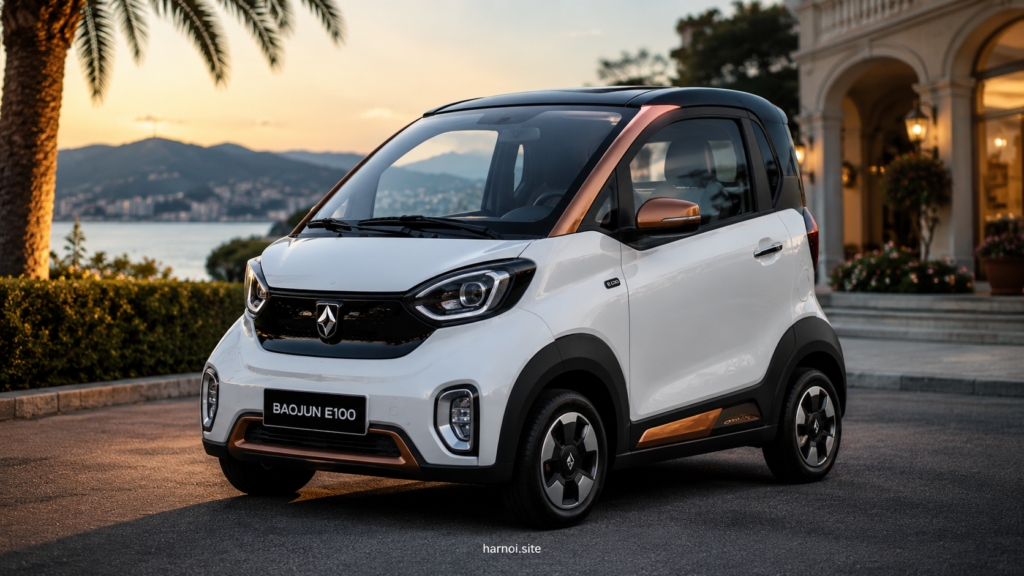
The Baojun E100 is a tiny, two-seat battery-electric city car built by SAIC-GM-Wuling (SGMW) — a joint venture between General Motors, SAIC Motor, and Wuling Motors — under the budget-focused Baojun sub-brand. Launched in 2016 and put into regular production in 2017, it was one of the first vehicles in Baojun’s electric microcar lineup and quickly became known as one of the cheapest mass-produced EVs in the world. It was designed from the outset as short-hop urban transportation rather than a highway car, and it was sold almost exclusively within China, starting in Guangxi province before expanding to Shandong.
Baojun E100 Overview
Think of the E100 as China’s answer to the smart fortwo: a stubby, two-door hatchback with room for a driver and one passenger, built to squeeze into crowded city streets and tiny parking spots. It was manufactured at SGMW’s Liuzhou plant in Guangxi and sold at a steep discount thanks to national and regional new-energy-vehicle subsidies. Its low price and small footprint made it hugely popular with local commuters, delivery workers, and first-time car buyers in the cities where it was available. Production later wound down, with SGMW shifting focus to successor and sibling models like the Baojun E200, E300, and the wildly popular Wuling Hongguang Mini EV.
Key Specifications
| Spec | Detail |
|---|---|
| Body style | 2-door, 2-seat hatchback |
| Drive motor | 29 kW (39 hp) permanent magnet synchronous motor |
| Torque | 110 Nm (81 lb-ft) |
| Top speed | 100 km/h (62 mph) |
| Battery | Lithium-ion, 14.9 kWh (early cars); later variants offered 17.3 kWh and 24 kWh packs |
| Range | 96 miles (155 km) at 2016 launch; up to 124 miles (200 km) after the 2018 update; later 24 kWh variants rated around 250 km |
| Charging | AC only, roughly 7.5 hours for a full charge |
| Turning radius | 3.7 meters |
| Suspension | Independent front, single-arm rear |
| Brakes | ABS with electronic brakeforce distribution, electronic parking brake |
Note that Baojun revised the E100 several times over its production run, so battery size and range figures differ depending on model year — early cars used a smaller pack than later ones.
Exterior Design
The E100’s design is unapologetically function-first. It has a short, rounded nose, a stubby tail with a rear hatch, and just two doors — there’s no pretense of rear seating. Small wheels (around 12 inches) sit under a body that’s noticeably taller than it is long, which maximizes headroom while keeping the overall footprint minimal. Roof rails, a two-tone paint scheme option (body color paired with an accent on the lower panels and B-pillar), and oversized headlights and taillights help it stand out despite its tiny proportions. It’s often compared visually to the smart fortwo, though the E100 is even smaller.
Interior Features
Inside, the E100 keeps things simple. It’s strictly a two-seater, with a flat floor made possible by mounting the battery pack beneath the seats — this frees up legroom and gives the cabin a more open feel than its exterior dimensions suggest. Higher trims added conveniences like automatic-folding mirrors and a rearview parking camera. The dashboard is minimalist, built around a small digital instrument cluster and (on many versions) a touchscreen for infotainment.
Battery Capacity and Range
The original E100 used a 14.9 kWh lithium-ion battery good for about 96 miles (155 km) of range. A mid-2018 refresh bumped that to roughly 124 miles (200 km) through battery and efficiency improvements. Later production years introduced larger packs — reports point to 17.3 kWh and 24 kWh options — pushing rated range up toward 250 km on some variants, though real-world range in daily driving would typically be lower than the manufacturer’s rated figures, especially in cold weather or with heavy air-conditioner use.
Charging Time and Charging Options
The E100 is AC-charging only — there’s no DC fast-charging capability. A full charge from empty takes around 7.5 hours on a standard home or public AC connection, which fits the car’s intended use case: overnight charging for short daily errands and commutes rather than long trips requiring quick top-ups.
Performance and Driving Experience
With 29 kW (39 hp) and 110 Nm of torque driving the front wheels through a single-speed transmission, the E100 is not fast — Baojun never published an official 0–100 km/h time, and the car’s electronically limited top speed of 100 km/h reflects its city-only design brief. What it does offer is the instant torque response typical of electric motors, which makes it feel reasonably peppy at low, urban speeds even if it runs out of breath quickly at higher ones. Its tight 3.7-meter turning radius makes it notably easy to maneuver and park in tight city environments.
Safety Features
Standard safety equipment includes anti-lock brakes with electronic brakeforce distribution, electric power steering, and an electronic parking brake. Later versions added rear parking sensors and ISOFIX child-seat anchors. That said, the E100 is a budget microcar without the advanced driver-assistance features (adaptive cruise control, lane-keeping assist, automatic emergency braking) common on modern mainstream EVs, and its crash safety was never assessed by international bodies like Euro NCAP, since it was never sold in markets that require that testing.
Technology and Infotainment
Tech is basic by design. Higher trims added a touchscreen (commonly cited around 7 inches) with Wi-Fi connectivity, giving owners access to basic infotainment and connected features. Software update support has historically been infrequent compared to premium EV brands, which is typical for a car built to hit an aggressive price point rather than compete on cutting-edge tech.
Comfort and Practicality
As a two-seater, the E100 isn’t for families, but for a single commuter or a couple it offers surprisingly usable space thanks to that flat, battery-under-seat floor. It’s tall for its footprint, which helps headroom and makes getting in and out easy. Practicality is centered entirely around city use: short commutes, errands, and navigating congested streets and tight parking — not road trips or carrying passengers beyond the front two seats.
Dimensions and Boot Space
The E100 is genuinely tiny: around 2,488 mm long, 1,506 mm wide, and 1,670 mm tall, with a wheelbase of about 1,600 mm. That makes it shorter than almost anything else on the road with four wheels. Boot space behind the two seats is modest — enough for grocery bags or a small backpack — reflecting its role as a two-seat city runabout rather than a family hatchback.
Pros and Cons
Pros:
- Extremely low purchase price, especially after Chinese NEV subsidies
- Tiny footprint makes parking and city maneuvering easy
- Tight turning radius
- Low running costs typical of EVs
- Simple, low-maintenance drivetrain
Cons:
- Two-seat-only layout limits practicality
- Modest range, especially on early models
- No DC fast charging — long charge times
- Limited safety tech versus modern EVs
- Never officially sold or supported outside select regions of China
- Production has ended, making parts and service harder to source over time
Baojun E100 Price
At launch, the E100 was priced around RMB 35,800 (about $5,600 USD at the time) after regional subsidies in Guangxi, with the pre-subsidy price closer to RMB 93,900–109,900. After the 2018 update, subsidized pricing ran roughly RMB 45,800–59,800 (about $7,200–$9,300 USD) depending on trim. Later model years were listed with MSRPs around RMB 59,800. Because pricing depended heavily on local and national subsidy programs that changed over time — and because the car was never sold through normal retail channels outside China — there’s no single “current” price; secondhand and gray-market listings are the main way to find one today.
Who Should Buy the Baojun E100?
The E100 made sense for a very specific buyer: someone in a Chinese city where it was officially sold, doing short daily commutes or errands, who wanted the cheapest possible entry into EV ownership and didn’t need to carry more than one passenger. It was popular with young, first-time car buyers, older residents wanting a simple runabout, and some small businesses using it for short-range logistics. It was never intended for families, highway commuting, or long-distance travel — and given that production has ended and the car was never officially exported to most markets, it isn’t a realistic option for buyers outside China today.
Baojun E100 vs Wuling Hongguang Mini EV
Both cars come from the same SGMW stable and target the same ultra-affordable EV segment, but they differ in a few important ways:
| Baojun E100 | Wuling Hongguang Mini EV | |
|---|---|---|
| Seats | 2 | 4 |
| Doors | 2 | 4–5 (depending on version) |
| Battery options | 14.9–24 kWh | 9.2–26.5 kWh (varies by generation/trim) |
| Range | Up to ~200–250 km depending on year | 120–300 km depending on battery |
| Status | Discontinued | Still in production, best-selling micro-EV in China |
| Market position | Niche, regional pilot car | Mass-market phenomenon, sold in huge volumes |
In short, the E100 was the trailblazer, but the Hongguang Mini EV took the same basic formula — cheap, tiny, electric — and scaled it into one of the best-selling vehicles in China, four seats and all. If you’re comparing the two purely on merit today, the Mini EV is the more practical, better-supported, and more widely available choice.
Common Problems and Reliability
Owners of early SGMW microcars like the E100 have reported the kind of battery degradation typical of entry-level EVs without sophisticated thermal management — noticeable range loss after three to five years of use isn’t unusual. Because the E100 was sold in a limited number of regions, service network coverage was strong in places like southern China but essentially nonexistent elsewhere, which becomes a bigger issue now that the model is discontinued and parts availability is shrinking. As with any budget EV, buyers considering a used example should have the battery health checked before purchase.
Maintenance and Running Costs
Like most EVs, the E100 benefits from simplified running costs — no oil changes, fewer moving parts, and lower servicing needs than a comparable gasoline microcar. Charging costs are minimal given the small battery size. The bigger practical challenge is parts and service access: since SGMW’s service network for the E100 was concentrated in the regions where it was originally sold, and production has since ended, sourcing replacement parts or specialized battery service has become progressively harder outside those areas.
Frequently Asked Questions (FAQ)
Is the Baojun E100 still in production? No. Production wound down as SGMW shifted focus to successor and sibling models such as the Baojun E200, E300, and the Wuling Hongguang Mini EV.
Can I buy a Baojun E100 outside China? Not through official retail channels — it was sold only in specific Chinese regions like Guangxi and Qingdao. Any unit found outside China would come through gray-market import or a private sale.
How far can the Baojun E100 go on a full charge? It depends on the model year: 96 miles (155 km) at launch, up to about 124 miles (200 km) after the 2018 refresh, and reportedly higher on later, larger-battery variants — though real-world range is usually lower than the rated figure.
Does the E100 have fast charging? No. It only supports AC charging, with a full charge taking around 7.5 hours.
How many people can the E100 seat? Two — it’s a dedicated two-seater.
Is the E100 safe? It has basic safety equipment (ABS, EBD, an electronic parking brake, and on later versions parking sensors and ISOFIX anchors), but it lacks the advanced driver-assistance systems found on modern EVs and was never independently crash-tested by international safety organizations.
Final Verdict
The Baojun E100 was never meant to be a global EV competitor — it was a low-cost, purpose-built solution for short urban trips in specific Chinese cities, and on that narrow brief, it succeeded, becoming a genuine sales hit in the regions where it launched. Its tiny size, tight turning circle, and rock-bottom price made it an easy entry point into EV ownership for a certain kind of buyer. But its two-seat layout, modest range, AC-only charging, and now-discontinued status mean it’s more of a historical stepping stone than a car worth seeking out today. If you’re interested in the concept but want something still in production, supported, and more practical, the Wuling Hongguang Mini EV — the E100’s spiritual successor — is the far more sensible choice.