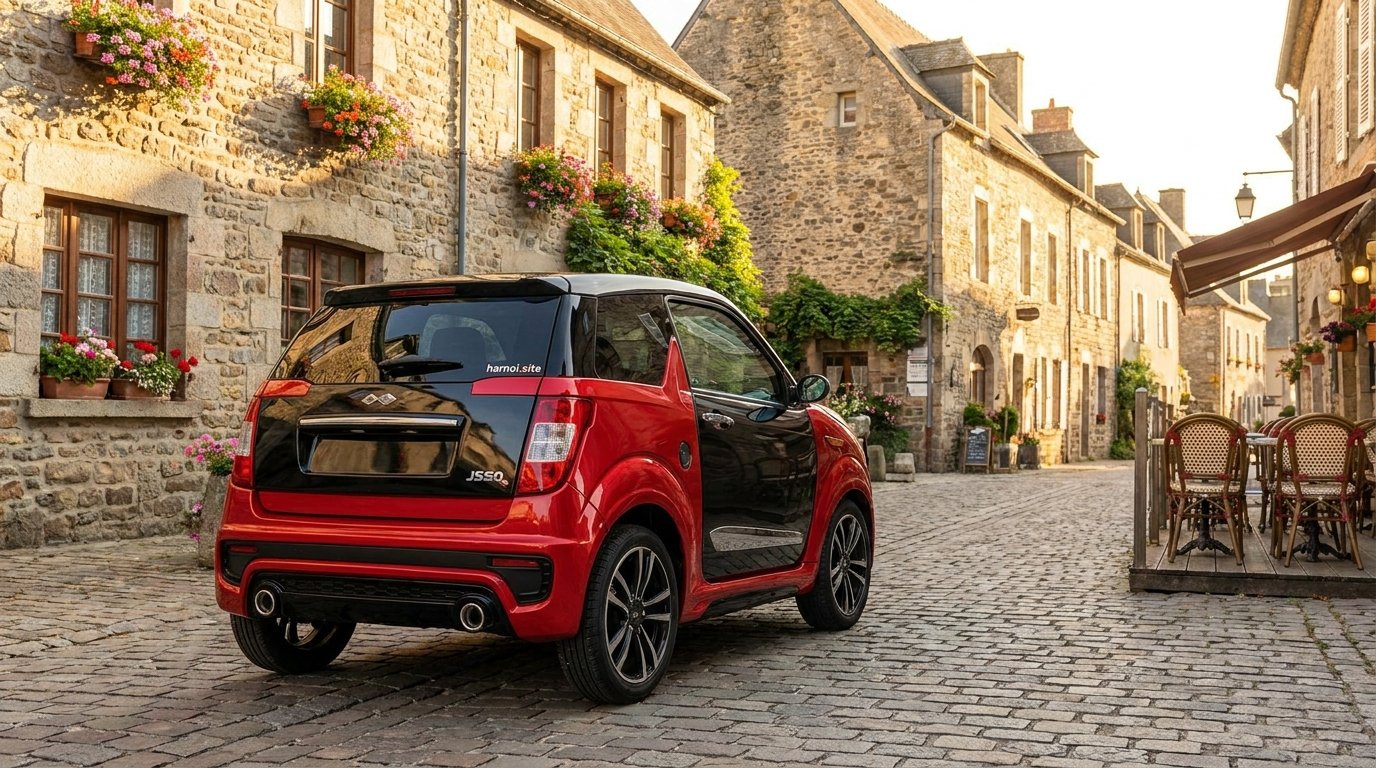
What is the Ligier JS50?
The Ligier JS50 is a French-built “voiture sans permis” (VSP) — a light quadricycle in the EU’s L6e category that can legally be driven without a full driving licence in many European countries, typically from age 14–16 with an AM licence. It’s built by Ligier, the manufacturer founded by former F1 driver Guy Ligier, and the JS50 name honors Jo Schlesser, a close friend and fellow racer of Guy Ligier’s; “50” simply marks it as the company’s 50th commercial model. It sits at the sportier, younger-skewing end of Ligier’s range, positioned above the entry-level MyLi.
Ligier JS50 Overview
The current-generation JS50 was fully redesigned inside and out, moving away from its earlier Citroën DS3-inspired silhouette toward its own, more angular identity. It’s sold in both diesel and, in its newest generation, fully electric form, aimed squarely at buyers cross-shopping the Citroën Ami, Fiat Topolino, and Aixam’s lineup. Ligier pitches it as the most “sporty” and tech-forward car in its range, leaning on a large touchscreen, ambient interior lighting, and a premium-for-the-class equipment list to stand out in a crowded no-licence segment.
Key Specifications
- Category: L6e light quadricycle (voiture sans permis)
- Length: approx. 2.97 m
- Curb weight: approx. 475 kg
- Doors / seats: 2 doors, 2 seats
- Drive: Front-wheel drive
- Diesel engine: ~0.5-litre single-cylinder diesel, roughly 5.4–8 hp depending on version and market, ~21–26 Nm of torque
- Electric motor: 6 kW (approx. 8 hp equivalent)
- Battery options (EV): 8.28 kWh or 12.42 kWh lithium-ion
- Top speed: 45 km/h (regulatory limit for the class)
- Transmission: Automatic (CVT-type)
- Wheels: Up to 16-inch alloys on top trims, Zeetex ZT1000 tyres
- Warranty: 24 months
Engine and Performance
The diesel JS50 uses a small single-cylinder unit producing roughly 8 hp, enough to reach the class-mandated 45 km/h top speed but not much more — some owners report the car struggling on steep gradients, dropping to around 33 km/h uphill against a nominal 45–50 km/h target. The engine isn’t especially refined; owners note noticeable vibration at cold idle (largely resolved by the optional DCI engine variant) and a certain roughness or jerkiness in the power delivery that’s typical of this class of single-cylinder diesel.
The electric version trades the diesel for a 6 kW Valéo motor — the same basic setup used in the Citroën Ami — running on a 48-volt system. With “Eco” mode switched off, acceleration is notably punchier than the diesel, giving the JS50 a more spirited character in town.
Fuel Economy
The diesel JS50 is rated at around 3.5 L/100 km, with CO2 emissions of roughly 93 g/km — modest figures, though the tiny top speed and short trip profile of these vehicles make absolute fuel cost very low regardless. The electric version’s range depends on battery size: Ligier quotes up to roughly 123 km on the smaller 8.28 kWh pack and up to around 192 km on the larger 12.42 kWh pack in mixed use, though cold-weather range drops sharply — some reviewers found real-world winter range falling to around 50 km, well below the roughly 80 km seen on the related MyLi in the same conditions.
Exterior Design
Design is one of the JS50’s stronger selling points relative to rivals. The redesigned front grille and twin-vent bumper give it a more aggressive, “athletic” face than the average VSP, and Ligier leans into the idea that this is a car that doesn’t try to hide what it is. Compared to the deliberately understated styling of rivals like Aixam, the JS50’s sharper creases and available alloy wheels give it a more youthful, sportier stance.
Interior and Comfort
Inside, the JS50 features bucket-style sport seats with contrast stitching and an exclusive ambient lighting setup — three illuminated red lines across the dashboard and door cards, a feature not commonly seen in this vehicle class. Build quality has reportedly improved over older Ligier models: owners of earlier examples note that newer bodywork ages and resists cracking better than the previous generation, and interior materials hold up reasonably well, though seat upholstery has been flagged as a wear point on higher-mileage cars.
Technology and Features
For a license-free microcar, the JS50’s tech list is unusually generous. It’s built around a large touchscreen (up to 10 inches) with Android Auto and Apple CarPlay, a reversing camera, dual USB sockets, wireless phone charging on some trims, and an upgraded Pioneer sound system. This equipment list is a genuine differentiator versus rivals like Aixam, which tend to keep infotainment more basic.
Safety Features
As with all L6e quadricycles, the JS50 is built to lighter crash-safety standards than a full passenger car, so expectations should be calibrated accordingly — these are not tested to the same Euro NCAP protocols as regular cars, and most models in the class, including the JS50, don’t offer airbags (a rare exception in the segment being the Mobilize Duo). LED daytime running lights and, since 2019, dual windshield wipers (up from a single wiper on earlier cars, a point owners specifically criticized for reducing visibility in heavy rain) are among the more practical safety-adjacent upgrades over time.
Dimensions and Cargo Space
At around 2.97 metres long, the JS50 is a genuinely tiny car — noticeably smaller than a city car but longer than the very compact Citroën Ami. Boot space is quoted at around 100 litres, which compares favourably to some Aixam models offering closer to 80 litres, though it remains modest even for the segment and multiple reviewers single out the trunk as smaller than some in-class alternatives.
Driving Experience
Road manners are frequently cited as one of the JS50’s genuine strengths. The available 16-inch wheels and Zeetex tyres give it noticeably good grip for the category, body roll in corners is well controlled, and ride comfort is described as good despite fairly firm suspension tuning. In town, the car’s agility and (on the electric version, with Eco mode off) brisk acceleration make it pleasant to drive within its 45 km/h ceiling. The diesel’s harsher, less smooth power delivery is the main knock against the driving experience compared to the electric model.
Pros and Cons
Pros
- Distinctive, sportier styling than most rivals in the class
- Strong tech and infotainment package for a license-free car
- Good grip and composed handling, especially on top trims with 16-inch wheels
- Bodywork on newer generations resists cracking and ages well
- Electric version offers brisker, smoother performance than the diesel
Cons
- Small boot relative to some competitors
- Diesel engine is rough and vibrates at cold idle
- Struggles on steep hills, falling well short of top speed
- Electric range drops significantly in cold weather
- Limited/no airbag protection typical of the L6e class
- Diesel powertrain faces upcoming emissions-standard pressure (Euro 5+)
Common Problems
Based on owner feedback and long-term reports, recurring issues include: cold-start vibration on the base diesel engine (largely fixed by opting for the DCI engine variant); an engine that isn’t smooth under load, with noticeable jerkiness; relatively fragile bodywork panels on some cars; a single front wiper on pre-2019 models that owners felt compromised visibility in heavy rain (Ligier added a second wiper from 2019 onward); and seat upholstery fraying with age and mileage. Weak climate control/ventilation has also been mentioned as a shortcoming by owners.
Maintenance and Service Costs
Ligier’s dealer network offers a widely-praised, responsive after-sales service, which owners repeatedly highlight as a strong point. That said, Aixam’s larger, more established dealer network means parts and specialist mechanics can be somewhat easier to find, particularly in rural areas, which can translate into marginally lower servicing friction and cost for Aixam owners versus Ligier. As with all VSPs, running costs are generally low given the tiny engines/motors and low mechanical complexity involved, though specialised diesel-quadricycle parts and labour aren’t always as cheap as for mainstream cars.
Reliability
Long-term owner reports describe the diesel engine as fundamentally reliable, even after tens of thousands of kilometres, with the main complaints centered on refinement (vibration, roughness) rather than outright failures. Bodywork durability has also improved meaningfully over older Ligier generations, which were more prone to cracking after a few years of use.
Who Should Buy the Ligier JS50?
The JS50 suits younger drivers (from the AM-licence minimum age in their country) wanting their first taste of independent mobility, adults who’ve lost their standard driving licence and need a legal alternative, and urban/semi-urban buyers who want a stylish, well-equipped microcar rather than the most utilitarian option in the class. Given its short range in cold weather (EV) and weak hill performance (diesel), it’s better suited to flat, short-distance urban use than hilly or long-commute scenarios.
Ligier JS50 vs Competitors
The JS50’s main rivals are the Aixam Coupé/Ambition/City range, the Citroën Ami, the Fiat Topolino, the Opel Rocks (an Ami rebadge), and the Microlino Lite. Versus Aixam, the JS50 generally wins on styling, tech, and cargo space, while Aixam tends to win on dealer network density and reputation for understated reliability. Versus the Citroën Ami, the JS50 (electric) offers more configurability with two battery sizes and a longer quoted range, while the Ami remains the cheaper, simpler, and best-selling option in the category.
Available Trims and Variants
The JS50 lineup typically spans Progress, Progress Sport, Progress Elegance, Sport, and top-spec Sport Ultimate trims, with progressively more equipment (larger wheels, ambient lighting, upgraded infotainment) as you move up the range. It’s offered with a base diesel engine, an optional smoother “DCI” diesel unit, and — in its latest generation — a fully electric powertrain with a choice of two battery capacities.
Price (New & Used)
New diesel JS50 pricing runs from roughly €13,300 for the Progress Sport trim to around €14,000 for higher trims, depending on market and options. Definitive pricing for the electric JS50 hadn’t been finalized in all markets at review time, but based on the closely related electric MyLi (from around €13,200 for the smaller battery to roughly €16,800 for the larger one), the electric JS50 is expected to land somewhere in a similar or slightly higher band, likely above €17,000 once official pricing is confirmed. Used examples vary widely by age, mileage, and engine choice, and since these are niche vehicles, it’s worth checking specialist VSP classifieds rather than mainstream used-car sites for realistic pricing.
Frequently Asked Questions (FAQs)
Do I need a driving licence to drive a Ligier JS50? No full licence is required in most of Europe; typically an AM licence (available from age 14–16 depending on the country) or, in France, no licence at all for those born before 1988, is sufficient, since it’s classed as an L6e light quadricycle.
What is the top speed of the Ligier JS50? It’s capped at 45 km/h, the regulatory limit for its vehicle category, regardless of engine choice.
Is the Ligier JS50 available as an electric car? Yes. The latest generation offers a fully electric powertrain with a 6 kW motor and a choice of two battery sizes, alongside the traditional diesel version.
How big is the boot? Around 100 litres, larger than some direct Aixam rivals but smaller than the roomier MyLi from the same manufacturer.
Does the Ligier JS50 have airbags? Generally no — like most vehicles in the L6e class, the JS50 is built to lighter crash-safety standards than full passenger cars and typically lacks airbags.
How does it compare to the Citroën Ami? The JS50 leans toward a sportier design and richer tech package with a choice of two battery sizes, while the Ami remains the cheaper, more minimalist, best-selling option in the segment.
Final Verdict
The Ligier JS50 is a competent, style-forward entry in the license-free microcar segment, distinguishing itself with genuinely good handling for the class, an unusually generous tech package, and sharper styling than most rivals. Its weaknesses — a rough diesel engine, modest boot space, hill-climbing struggles, and cold-weather range loss on the EV — are largely typical growing pains of the L6e category rather than dealbreakers unique to Ligier. For buyers who value design and equipment over ultimate practicality or the widest dealer network, the JS50 is one of the more appealing choices in its class; those prioritizing simplicity, dealer support, or outright reliability reputation may still lean toward Aixam or the cheaper Citroën Ami.
Leave a Reply