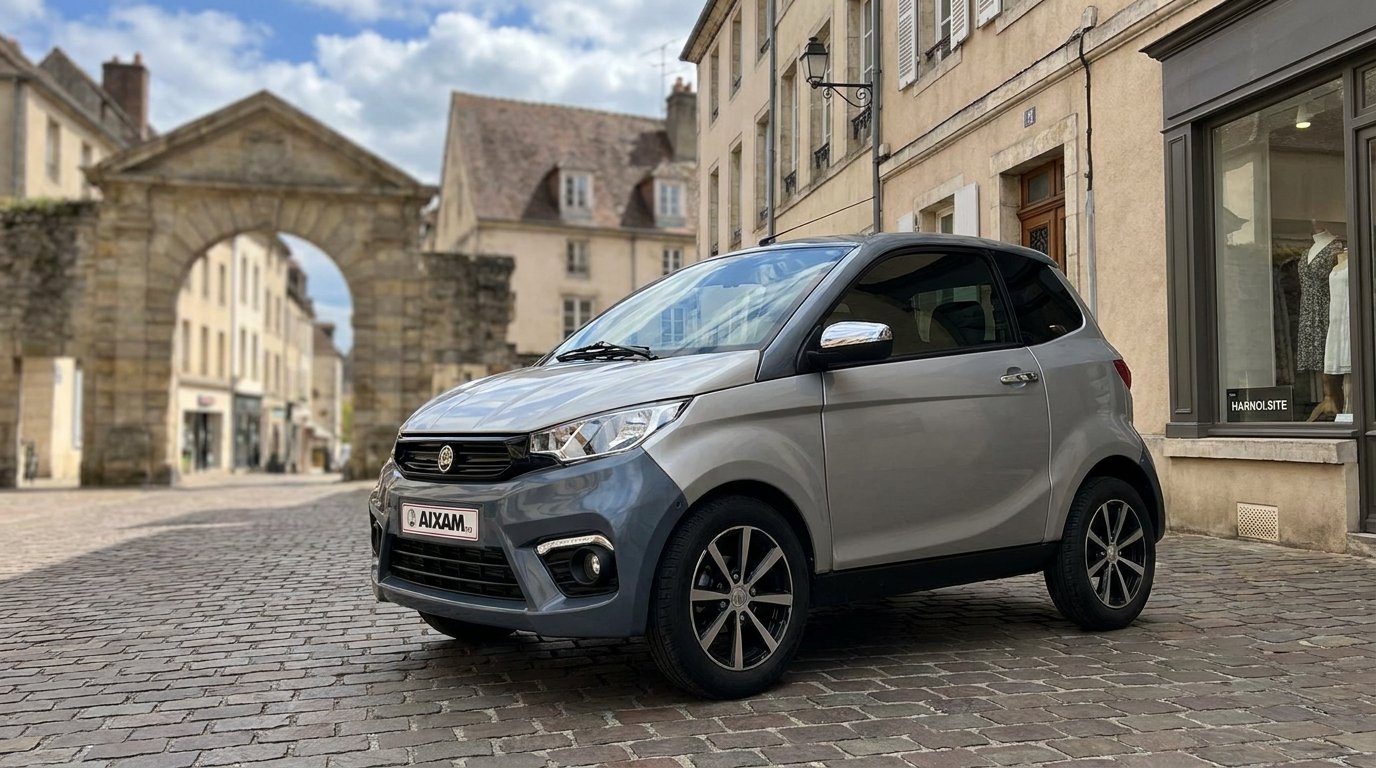
Aixam City Overview
The Aixam City is France’s best-selling licence-free microcar — a compact, two-seat quadricycle built by Aixam in Aix-les-Bains, Savoie. It isn’t a “car” in the conventional sense: it’s a light quadricycle (EU category L6e), electronically capped at 45 km/h, that can legally be driven in much of Europe without a standard driving licence — by 14-16 year-olds with an AM moped licence in some countries, or by anyone born before certain grandfathered dates who never held a car licence. Aixam pitches the City as an accessible, low-cost, enclosed alternative to a scooter, aimed at teenagers, seniors who’ve lost their licence, and anyone who simply wants weatherproof, low-speed urban transport.
The City nameplate spans several trims — Pack, Sport, and GTO among the diesel range, plus an e-City electric version — with prices in France running from roughly €14,700 for the base Pack to around €18,000 for the sportiest GTO.
History of the Aixam City
Aixam was founded in 1983, growing out of the earlier Arola microcar company, and has spent four decades specializing almost exclusively in license-free vehicles. The Aixam City nameplate arrived in 2008, launched to coincide with the brand’s 25th anniversary, replacing the earlier A.721 line and joining a refreshed range that also included the Roadline and Crossline models. It was built around a modular platform designed to hit a target of roughly 3 L/100km fuel consumption and sub-80 g/km CO2 emissions in combustion form, using a steel/aluminium structure with an ABS plastic body.
A major styling and technical update followed in 2016, and the City has been progressively refreshed since — including a 2026 redesign under Aixam’s new “Ambition” range, which brought a full-LED light signature, a revised “Aixam Cockpit” dashboard with a digital instrument screen, and glossier trim. Aixam was acquired by U.S. powersports giant Polaris Industries in 2013, and the company has since added electric variants (the e-City) alongside its traditional Kubota diesel lineup.
Exterior Design
The City wears a scaled-down, conventional-hatchback silhouette rather than an overtly “toy car” look — a 3-door body with a rounded nose, integrated LED daytime running lights built into the headlamp units, and a tailgate-style rear hatch. Trim-dependent styling cues include a glossy black front grille, dual-tone paint options, and 14 to 16-inch alloy wheels depending on the version. The sportier City Sport and City GTO add visual aggression: glossy black grilles and pillars, contrasting roof packs, dual (cosmetic) exhaust-style tailpipe finishers, racing stripes, and larger diamond-cut alloys. Five to six exterior colors are typically offered, including Mallard Blue, Pearl Red, Pure White, Silver Grey, and Titanium Grey.
Interior and Cabin Features
Inside, the City punches above its size class for a vehicle this small. The dashboard — branded the “Aixam Cockpit” — is an injection-moulded, leather-grained panel with glossy black inserts, and higher trims get a TFT digital instrument screen (3.5 inches on Sport/GTO) in place of simple analogue dials. A touchscreen infotainment display (7-inch on Pack, up to 10-inch with wireless CarPlay/Android Auto on GTO) handles audio and the reversing camera feed.
Seating is limited to two, with fabric upholstery on the entry Pack trim moving up to leather or tri-material blends with contrast stitching on Sport and GTO. Storage is genuinely practical for the vehicle’s size: a front cubby-hole, door pockets, a glove box with integrated cup and coin holders, and a modular boot.
Engine Specifications
The standard City is powered by a front-mounted, transverse, liquid-cooled 2-cylinder Kubota diesel engine, sized at either 400cc (earlier/entry versions) or 479cc (the current standard unit), producing 6 kW (around 8 hp) at 3,200 rpm with 21 Nm of torque at 2,500 rpm. Power reaches the front wheels through a single-speed automatic transmission (effectively a CVT-style regulator with forward, neutral, and reverse) — there’s no manual gearbox or clutch pedal to operate. A 12V/60A alternator and 12V/41Ah battery support the electrics. An electric e-City variant is also available, using a similarly rated 6 kW motor.
Performance and Driving Experience
Performance figures need to be read in context: this is a regulatory-limited urban runabout, not a sports car. Top speed is electronically capped at 45 km/h (28 mph) across the range, in line with the light-quadricycle rules that allow it to be driven without a full car licence. Steering is rack-and-pinion with a tight 4-metre turning radius, making it exceptionally manoeuvrable in city traffic and parking. Suspension is independent all round — MacPherson-type struts at the front and trailing-arm/coil-spring setups at the rear — tuned more for compliance over broken urban surfaces than for cornering sharpness. Braking is by discs at the front (220mm) and drums at the rear (160mm), with the option of adding ABS and EBD on some trims. In everyday use, owners describe the City as easy and unintimidating to drive, with light controls and excellent visibility, but acceleration is modest by design and the car is best suited to town and low-speed suburban roads rather than fast dual carriageways.
Fuel Economy and Efficiency
Aixam quotes fuel consumption for the current diesel City Pack at around 4.3 litres per 100 km, with CO2 emissions of roughly 113 g/km, and a 16-litre fuel tank yielding a real-world range of about 350 km. Older/lighter versions of the City with the smaller 400cc engine reportedly returned even more frugal figures, closer to 3 litres per 100 km with a claimed range up to 450-500 km, though these numbers vary by source and testing method. Either way, running costs at the pump are very low, which is part of the model’s core appeal alongside the electric e-City’s zero tailpipe emissions.
Dimensions and Weight
The Aixam City is genuinely compact: roughly 2.75-2.79 metres long, about 1.5 metres wide, and built on a wheelbase of around 1.75-1.8 metres, with front and rear tracks of roughly 1.35 metres. Unladen weight sits at approximately 350-425 kg depending on version and equipment, with an authorised gross weight (including driver, passenger, and cargo) capped around 640-675 kg — this low weight is essential to the vehicle’s L6e quadricycle classification and its exemption from full car-licence requirements.
Safety Features
Standard safety equipment includes full-LED headlights and taillights, reinforced front and rear bumpers, reinforced doors, a high-resistance chassis (aluminium or steel-reinforced depending on generation), automatic hazard-light activation under hard braking, and a “headlights on” audible warning. ABS with electronic brakeforce distribution (EBD) is available as a factory option rather than standard fitment on most trims, and there is no airbag offering on the mainstream City range.
It’s important to be candid here: heavy quadricycles as a category have performed poorly in independent crash testing. Euro NCAP’s dedicated quadricycle assessments — which have included sibling Aixam models like the Crossover GTR — have repeatedly found that vehicles in this class offer occupant protection far below that of a modern small passenger car, citing structural weaknesses and inadequate restraint systems even at moderate test speeds. Buyers should understand that the City’s safety case rests primarily on its very low top speed rather than crashworthiness engineering comparable to a conventional automobile.
Technology and Infotainment
Tech provision has grown noticeably in recent model years. Entry Pack trim gets a 7-inch LCD touchscreen with radio, MP3, RDS, USB, and Bluetooth, plus rear parking sensors. Sport trim upgrades to a 7-inch TFT touchscreen, adds a reversing camera, and moves to a 4-speaker hi-fi system. Top GTO trim brings a 10-inch TFT touchscreen with wireless Apple CarPlay/Android Auto support, a 6-speaker hi-fi setup, and scrolling front/rear indicators. All trims get a digital instrument panel of some kind (a “23-inch floating panoramic display” per Aixam’s own terminology for the combined screen area), keyless-style flip-key remote locking, and a dedicated USB charging port.
Comfort and Practicality
Despite its footprint, the City offers a surprisingly usable boot — Aixam quotes a modular capacity ranging from 291 up to 492 litres (some listings cite figures as high as 422-600 litres depending on configuration and measurement standard), thanks to a wide tailgate opening and low loading lip. A 3-speed heating, ventilation, and demisting system, electric windows, central locking, tinted windows, and a heated driver’s seat (optional) round out daily livability. Air conditioning is available as a factory option rather than standard equipment on most trims.
Pros and Cons
Pros:
- Drivable without a full car licence in much of Europe — genuine mobility solution for teens, seniors, and licence-restricted drivers
- Very low fuel consumption and running costs
- Tiny footprint and tight turning radius make parking and urban manoeuvring effortless
- Surprisingly well-equipped cabin with touchscreens, digital dashboards, and reasonable boot space
- Simple, low-maintenance mechanicals (no clutch, straightforward CVT-style transmission)
- Enclosed, weatherproof cabin — a genuine step up from a scooter or moped
Cons:
- Top speed limited to 45 km/h — unsuitable for anything beyond town and low-speed roads
- Weak crash-test performance relative to conventional passenger cars; no airbags on the standard range
- Only two seats and modest power (around 8 hp)
- Purchase price is high relative to the performance and size on offer, compared with a cheap used supermini
- ABS and air conditioning are extra-cost options rather than standard on base trims
Common Problems and Reliability
Aixam’s Kubota-sourced diesel engines have a strong industrial-engine pedigree and are generally regarded as robust and simple, with the brand citing hundreds of thousands of units in service. Common owner/mechanic-reported issues on Aixam microcars in general (across the City and related models) tend to center on the CVT-style automatic transmission belt and pulley system, which is a wear item requiring periodic replacement, along with the drive belt tensioner. Because these vehicles are used almost exclusively for low-speed, stop-start urban driving, clutch/regulator wear and small-bore fuel-system issues (particularly on older, higher-mileage examples) are the most frequently cited problems in owner forums and independent dealer reviews, rather than major engine failures. Because Aixams are a niche product with a limited independent servicing network outside dedicated dealers, parts availability and repair costs can be a bigger practical concern than mechanical fragility itself.
Maintenance and Service Costs
Routine maintenance costs are generally lower than for a conventional car, given the small, low-stressed diesel engine and simple drivetrain, though servicing must usually go through an Aixam dealer network rather than an independent general garage, which can push labour costs up in some regions. Aixam’s purchase price typically bundles a first 1,000 km service and a two-year roadside assistance plan. Tyres, brake pads, and the transmission belt are the main wear items to budget for over the ownership period.
Aixam City Price
In France, current list pricing for the diesel City range starts at approximately:
- City Pack: from €14,699
- City Sport: from €16,799
- City GTO: from €17,999
The electric e-City Pack starts lower, from around €14,399. Lease/financing plans are also offered, with the Pack available from roughly €211/month plus a €2,000 initial payment in Aixam’s French market financing example. Pricing and availability vary significantly by country and dealer network, and the City is not officially sold in North America.
Who Should Buy the Aixam City?
The Aixam City makes most sense for a fairly specific set of buyers: teenagers as young as 14-16 in countries that permit AM-licence quadricycle use, older drivers who have lost or given up a standard driving licence but still want private, weatherproof transport, and people living in dense town centres who rarely need to exceed 45 km/h. It’s a poor fit for anyone who regularly drives on faster roads, needs to carry more than one passenger, or wants strong crash protection — a small, cheap used conventional car will usually outperform it on safety and value per euro for drivers who hold a full licence.
Aixam City vs Competitors
The City’s closest rivals are other French and European heavy-quadricycle makers, chiefly Ligier (with its JS and Myli ranges) and Microcar (owned by the same Ligier Group), along with Chatenet. These competitors occupy essentially the same niche: 45 km/h-limited, licence-free two-seaters with diesel or electric power, similar pricing, and comparable Euro NCAP quadricycle test results. Differentiation between brands tends to come down to styling, dealer network density in a given country, and small equipment differences (touchscreen size, optional ABS, upholstery) rather than any fundamental mechanical advantage — none of the segment’s players offer airbags or passenger-car-level crash structures as standard.
Frequently Asked Questions (FAQs)
Do you need a driving licence to drive an Aixam City? In many European countries — including France, Belgium, Spain, and others — the City can be driven with only an AM moped-category licence (available from age 14-16 in some countries) or, for older drivers born before certain grandfathered dates, with no licence at all. Requirements vary by country, so local rules should always be checked.
How fast does the Aixam City go? It’s electronically limited to 45 km/h (28 mph), a legal requirement for its L6e quadricycle classification.
Is the Aixam City safe? It meets the specific quadricycle safety regulations required for road use, but independent Euro NCAP testing of similar heavy quadricycles has consistently found weaker occupant protection than conventional passenger cars, and airbags are not offered on the standard range.
Is there an electric version? Yes — the e-City, with a similarly rated electric motor, sold alongside the diesel range.
How much does an Aixam City cost? In France, prices for the current lineup start at roughly €14,700 for the base diesel Pack trim and rise to around €18,000 for the sportier GTO.
Final Verdict
The Aixam City fills a genuinely useful and fairly unique niche: legally accessible, enclosed, weatherproof personal transport for people who can’t or don’t want to get a full driving licence. Within that narrow brief, it does its job well — it’s cheap to run, easy to park, and better equipped inside than its size suggests. But buyers need to go in with realistic expectations: it’s not a substitute for a real car on faster roads, and its crash-safety credentials lag well behind anything with a conventional car licence requirement. For its intended audience — teens, licence-restricted seniors, and dedicated town-only drivers — it remains one of the most credible options in the European microcar segment; for anyone who could instead buy and insure a small used conventional car, it’s a harder case to make on pure value grounds.
Leave a Reply