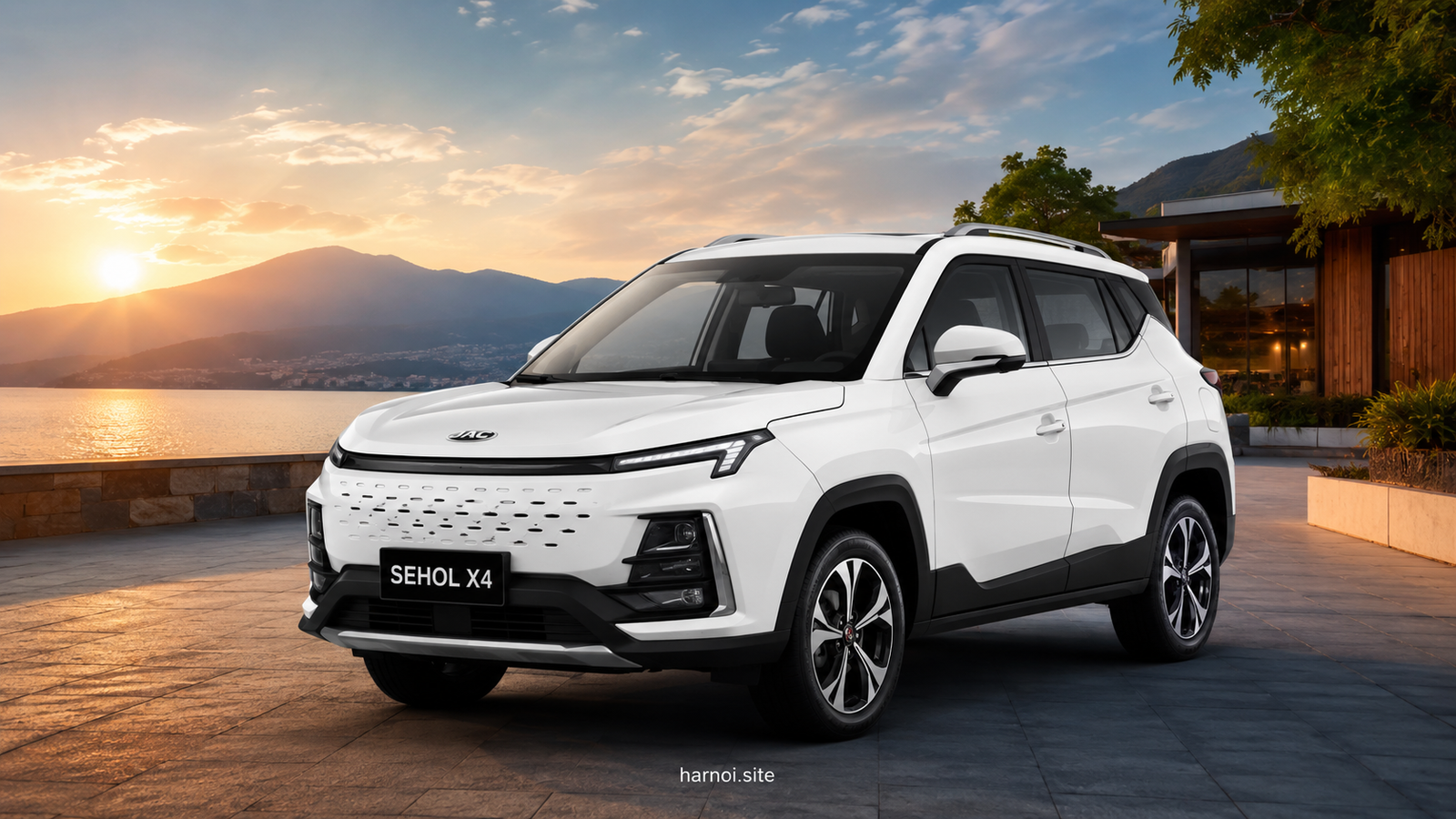
A quick note before you read on: the Sehol X4 is not an officially imported model in Pakistan — you won’t find it on JAC’s local lineup at Ghandhara Automobiles (which currently sells the JAC X200 and JAC T9 here). It’s sold in China, and as rebadged versions elsewhere: the Moskvitch 3 in Russia, the JAC T60 Plus in Brazil, and the GTV Kessor in Cambodia. This guide covers the car based on its global specs so you know exactly what you’d be getting if you’re considering a gray import, or just researching JAC’s global range. If pricing in your local currency isn’t mentioned, that’s why.
Overview of the JAC Sehol X4
The Sehol X4 is a subcompact crossover SUV built by JAC Motors under its Sehol (formerly “Sol”) sub-brand. It’s essentially a heavily facelifted, more style-focused version of the older JAC Refine S4, first launched in China in mid-2020 and still on sale there today. It sits in JAC’s lineup as an affordable, city-friendly crossover aimed at buyers who want SUV looks and a bit more ride height than a hatchback, without stepping up to a full mid-size SUV price tag.
An all-electric sibling, the Sehol E40X, shares the same body but runs a battery-electric powertrain instead.
Key Specifications
| Spec | Detail |
|---|---|
| Body style | 5-door, 5-seat subcompact crossover |
| Length / Width / Height | 4,410 mm / 1,800 mm / 1,660 mm |
| Wheelbase | 2,620 mm |
| Curb weight | ~1,365–1,375 kg |
| Engine | 1.5L turbocharged inline-4 petrol |
| Power / Torque | 150 hp / 210 Nm |
| Transmission | 6-speed manual (standard) or CVT (optional) |
| Drivetrain | Front-wheel drive only |
Engine Performance
Every Sehol X4 uses the same 1.5-liter turbo-petrol four-cylinder, producing 150 hp and 210 Nm of torque. That’s a healthy output for a car this size — comfortably more than most naturally aspirated 1.5–1.6L engines from rivals in the segment. Power goes to the front wheels only through either a 6-speed manual or a CVT automatic. There’s no diesel, hybrid, or AWD option on the petrol version. In everyday driving, the turbo motor pulls well from low revs, so it doesn’t feel strained around town, and it has enough mid-range punch for confident highway overtaking.
Fuel Economy & Mileage
JAC hasn’t published a widely-verified WLTP or EPA figure for the X4, but based on the engine’s output and class positioning, real-world economy typically falls in the range other 1.5T compact crossovers achieve — roughly 12–15 km/l in mixed driving, better on the highway and lower in heavy city traffic. The CVT variant tends to sip slightly less fuel than the manual in stop-start conditions, while the manual can be more efficient for drivers who use it well on the open road.
Exterior Design
This is where the “facelift” work really shows. Compared to the boxier Refine S4 it replaced, the X4 gets a wider chrome-slat grille, sleeker LED headlamp clusters, a more sculpted hood, and a floating-roof effect on higher trims created by a black-painted C-pillar. At the rear, a full-width LED tail-light bar gives it a more modern, expensive-looking silhouette than its price point would suggest. Overall, it reads as a car trying — successfully, for the most part — to punch above its budget-segment origins visually.
Interior Features & Comfort
Inside, the cabin favors straightforward usability over flashy design: a digital instrument cluster paired with a central touchscreen, simple physical climate controls, and a layout clearly built for daily commuting rather than a “premium” experience. Materials are cost-appropriate for the segment — durable rather than plush — but the layout is easy to learn at a glance. Higher trims add niceties like a panoramic sunroof (on export variants like the GTV Kessor) and heated front seats on cold-climate markets like Russia. Space is respectable for the exterior footprint, though rear headroom and legroom are more “compact” than “mid-size.”
Technology & Infotainment
The infotainment setup centers on a touchscreen display handling media, and on some markets, connected services and navigation. It’s functional rather than cutting-edge — don’t expect the large, tiled, over-the-air-updatable systems JAC uses on newer models like the Sehol X6. USB charging ports and basic smartphone connectivity are standard, but full wireless CarPlay/Android Auto availability varies by market and trim, so it’s worth confirming on the specific unit you’re looking at.
Safety Features
Standard passive safety includes dual front airbags and ISOFIX child-seat anchors across trims, with higher trims adding up to six airbags (front, side, and curtain). On the active safety side, ABS with EBD, brake assist, traction control, and electronic stability control are fitted uniformly across the range. Export versions like the GTV Kessor add extras such as a 360-degree camera system and some driver-assistance features, though the X4 generally sits below rivals that offer full ADAS suites (adaptive cruise control, automatic emergency braking, lane-keep assist) as standard.
Driving Experience
The turbo engine is the highlight — it feels eager and responsive for the class, with none of the lethargy you sometimes get from smaller-displacement rivals. The CVT is tuned for smoothness over sportiness, which suits the car’s commuter brief. The manual gearbox is a reasonably slick unit, giving more engaged drivers a bit more control over the power band. It won’t excite a keen driver, but for daily errands and highway cruising, it does the job without drama.
Ride Quality & Handling
As a front-wheel-drive crossover riding on a fairly conventional suspension setup, the X4 prioritizes comfort over cornering sharpness. It absorbs rough patches and speed bumps reasonably well, and the ride height gives a bit more visibility and confidence over uneven surfaces than a standard hatchback. Body roll is present in quicker corners, as expected for the segment, but the car stays composed and predictable at normal driving speeds.
Cargo Space & Practicality
With a 2,620 mm wheelbase and compact overall footprint, the X4 offers usable — if not class-leading — boot space, adequate for weekly grocery runs, a couple of suitcases, or a stroller and bags. The rear seats fold to extend cargo capacity when needed. It’s a practical shape for city parking too, with dimensions that make it easy to maneuver and park compared to larger SUVs.
Trim Levels & Available Variants
Trim structures differ by market, but generally the X4 range spans:
- Base trims — manual transmission, cloth seats, fewer driver-assistance features
- Mid trims — CVT option, upgraded infotainment, additional convenience features
- Top trims — panoramic sunroof, more airbags, upgraded safety tech, and cosmetic extras like the black-roof two-tone treatment
The all-electric Sehol E40X is sold as a separate model line, with 55 kWh or 66 kWh battery options offering an NEDC-rated range of roughly 420–502 km.
Pros and Cons
Pros:
- Strong, punchy 150 hp turbo engine for the class
- Modern, more premium-looking exterior design than its price suggests
- Comfortable, easy-to-live-with ride for daily commuting
- Reasonable practicality for a compact footprint
- Competitive standard safety kit (ABS, EBD, ESC across the range)
Cons:
- No AWD option — front-wheel drive only
- Infotainment and interior tech trail newer JAC/Sehol models
- Limited advanced driver-assistance features versus rivals in some markets
- Not officially sold in many markets (including Pakistan), which affects parts and resale
- Interior materials feel budget-appropriate rather than premium
Common Problems & Reliability
As a China-market-first model exported in relatively small numbers, independently-verified long-term reliability data on the X4 is limited compared to established Japanese or Korean rivals. Owners of the Russian Moskvitch 3 version (mechanically identical) have reported the usual growing pains associated with newer manufacturing lines transitioning to full local production, along with typical turbo-petrol maintenance items like turbocharger longevity and CVT servicing being areas to keep an eye on. As with any lesser-known import, it’s wise to check a specific unit’s service history carefully before buying used.
Maintenance and Service Costs
Routine maintenance costs for a 1.5T turbo-petrol engine tend to be moderate — turbocharged engines generally call for stricter oil-change intervals and quality oil than naturally aspirated units of the same size. Where JAC has an official presence (China, Brazil, Russia via Moskvitch), dealer servicing is straightforward. In markets without an official JAC/Sehol presence, servicing usually falls to independent mechanics familiar with Chinese-brand vehicles, which can mean more legwork to find someone experienced with the platform.
Spare Parts Availability
This is the X4’s biggest practical weak point outside its core markets. Because it’s not officially distributed everywhere, spare parts availability — especially model-specific trim, electronics, and body panels — can be inconsistent outside China, Brazil, and Russia. If you’re considering a gray-imported unit in a market like Pakistan, budget extra time (and potentially cost) for sourcing parts, and consider the availability of a JAC-experienced independent workshop in your area before committing.
JAC Sehol X4 vs Competitors
| Model | Engine | Power | Drivetrain | Notable Edge |
|---|---|---|---|---|
| JAC Sehol X4 | 1.5T petrol | 150 hp | FWD | Strong power-to-price ratio, sharp styling |
| Changan CS35 Plus | 1.4T/1.6L petrol | 120–158 hp | FWD | Wider official market presence |
| Haval Jolion | 1.5T petrol | 145–169 hp | FWD | More advanced infotainment/ADAS |
| MG ZS | 1.5L/1.5T petrol | 106–160 hp | FWD | Stronger brand recognition, wider service network |
In head-to-head terms, the X4 holds its own on raw engine output and styling but tends to fall a step behind more established Chinese-brand rivals (Haval, MG, Changan) on infotainment sophistication, official market support, and resale confidence — largely because those brands have invested more heavily in official distribution and after-sales networks in markets outside China.
Who Should Buy the JAC Sehol X4?
The X4 makes the most sense for buyers who:
- Live in (or can source the car through) a market with official JAC/Sehol or Moskvitch support
- Want strong turbo-petrol performance in a compact, city-friendly footprint
- Prioritize looks and daily-driving comfort over cutting-edge tech
- Are comfortable with a lesser-known brand in exchange for a competitive price
It’s a harder sell for buyers who need guaranteed nationwide parts and service support, want the latest ADAS safety tech, or are buying in a market — like Pakistan — where the model isn’t officially sold, since resale value and long-term ownership costs become harder to predict.
Frequently Asked Questions (FAQs)
Is the JAC Sehol X4 available in Pakistan? No, it’s not part of JAC’s official Pakistani lineup (currently the X200 and T9). Buyers only encounter it here, if at all, through gray/private imports.
What engine does the Sehol X4 use? A 1.5-liter turbocharged petrol engine producing 150 hp and 210 Nm of torque, paired with a manual or CVT transmission.
Is there an electric version? Yes — the Sehol E40X, sold as a separate model with 55 kWh or 66 kWh battery packs and an NEDC range of up to roughly 502 km.
Is the Sehol X4 the same as the Moskvitch 3? Mechanically, yes. The Moskvitch 3 is a rebadged Sehol X4 built (initially via SKD assembly) in Russia.
Does it come with all-wheel drive? No, the X4 is front-wheel drive only across all petrol variants.
Final Verdict: Is the JAC Sehol X4 Worth Buying?
The JAC Sehol X4 is a genuinely competitive package on paper — a punchy turbo engine, modern styling, and decent everyday comfort at a price that undercuts many established rivals. Where it stumbles is everything around the car itself: official market availability, long-term parts support, and infotainment/safety tech that lag newer competitors. If you’re in a market where JAC/Sehol has real dealer support, it’s worth serious consideration as a value-focused crossover. If you’re looking at it as an import in a market like Pakistan where there’s no official backing, the appealing spec sheet is offset by real risk around servicing, parts, and resale — worth going in with eyes open.
Leave a Reply