1. Introduction
The Borgward BX5 is a subcompact luxury crossover built by Foton Motor under the revived Borgward brand — a name with German roots that traces back to the original Carl F. W. Borgward company, which folded in 1961. Foton acquired the rights to the Borgward name and relaunched it as a China-focused brand, with the BX5 debuting at the 2016 Geneva Motor Show and reaching Chinese showrooms in March 2017. It later expanded to a handful of export markets, including parts of the Middle East, but it has never been officially sold in North America or most of Western Europe.
The BX5 positions itself as an affordable, feature-rich alternative to more established compact SUVs, wrapping turbocharged four-cylinder power and a German-flavored design language around a Chinese-market price tag. This review covers what to expect from the BX5 across design, performance, comfort, technology, and ownership — and is honest about where independent, long-term data on this niche model is thin.
2. Borgward BX5 at a Glance
Quick Summary
The BX5 is a five-seat, front-engine crossover offered with two turbocharged petrol engines (1.4L and 1.8L), front-wheel drive as standard and all-wheel drive as an option, paired with a 6-speed automatic transmission. It sits in the same broad segment as the Honda CR-V or Nissan Qashqai in size, but undercuts many rivals on price in the markets where it’s sold.
Pros & Cons (Summary)
Pros:
- Distinctive, upscale-looking exterior for the price
- Punchy turbocharged engines, especially the 1.8L
- Well-equipped cabin with a full suite of driver-assistance features on higher trims
- Competitive pricing versus mainstream compact SUVs
Cons:
- Very limited dealer and parts network outside China and a few export markets
- Sparse independent long-term reliability data
- Resale value is uncertain given the brand’s limited global footprint and its financial troubles in China
- Not sold in the US, UK, or most of Western Europe
3. Exterior Design
Front Design
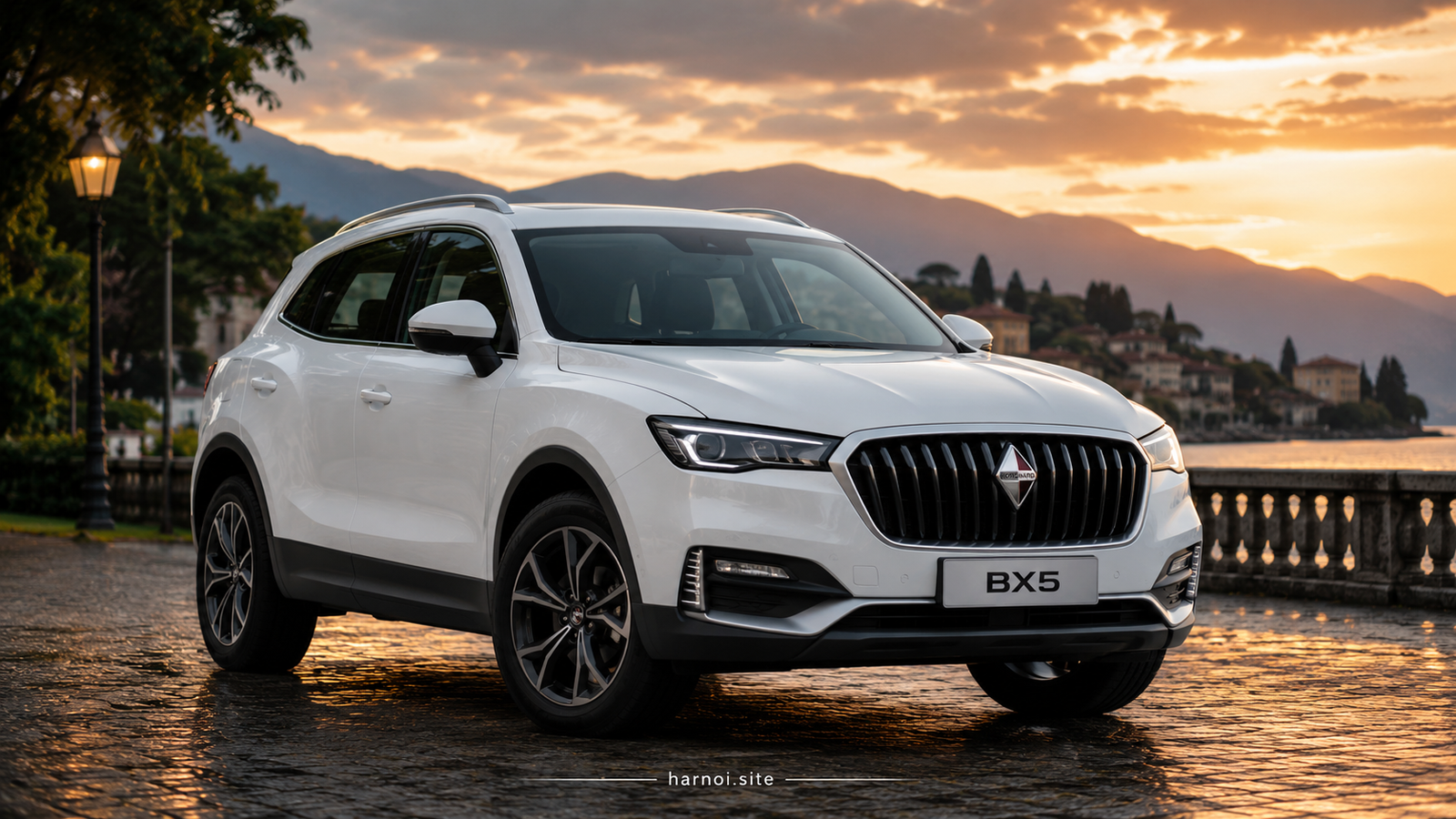
The BX5’s nose is dominated by a large hexagonal grille flanked by angular headlamp clusters, a design language clearly aimed at projecting a premium, German-adjacent identity. LED daytime running lights and available LED headlights are featured on upper trims.
Side Profile
A sculpted character line runs from the front fender to the rear taillights, and roof rails come standard on most trims, reinforcing the SUV silhouette. Alloy wheel sizes vary by trim, generally ranging from 17 to 19 inches.
Rear Styling
The rear features wraparound taillights and a two-tone bumper design on higher trims, with a shark-fin antenna and rear roof spoiler adding some visual sportiness.
Dimensions
The BX5 measures approximately 4,490 mm in length, 1,877 mm in width, and around 1,675 mm in height, with a wheelbase of about 2,685 mm. These dimensions place it firmly in the compact-to-subcompact crossover class, with cabin space that’s competitive for the segment though not class-leading.
4. Interior & Cabin Quality
Dashboard
The dashboard layout emphasizes a horizontal design with a floating touchscreen, soft-touch materials on the upper surfaces of higher trims, and piano-black or brushed-metal-look accents depending on trim level.
Seats
Seating is generally cloth on base trims and leather or leatherette on upper trims, with available power adjustment and heating for the front seats on top-spec models. Reviewers and owners in Chinese and Middle Eastern markets have generally described the seats as comfortable for daily use, though long-distance support has drawn mixed feedback.
Cargo Space
Cargo capacity is adequate for the segment, with rear seats that fold to expand storage, though the BX5 doesn’t stand out as a class leader for outright cargo volume compared to larger compact SUVs.
Build Quality
Fit and finish is generally regarded as solid for the price point, though panel gaps and interior plastic quality on lower trims have been noted as areas where the BX5 doesn’t quite match more established brands like Volkswagen or Honda.
5. Engine Specifications
Engine Type
The BX5 is offered with two turbocharged, direct-injection petrol four-cylinder engines: a 1.4L unit and a 1.8L unit. A more powerful 2.0L turbo (carried over from the larger BX7) has also been offered on some all-wheel-drive variants in certain markets.
Horsepower
- 1.4L turbo: approximately 148–150 hp
- 1.8L turbo: approximately 188–190 hp
- 2.0L turbo (select AWD variants): approximately 221–224 hp
Torque
- 1.4L turbo: approximately 250 Nm
- 1.8L turbo: approximately 280 Nm
Transmission
All BX5 variants use a 6-speed automatic transmission as standard, paired with front-wheel drive or optional four-wheel drive depending on the engine and trim.
6. Performance Review
Acceleration
The 1.8L turbo is the pick of the range for anyone who wants brisker acceleration, with enough low-end torque to make merging and overtaking feel confident for a crossover in this class. The 1.4L is adequate for city use but feels noticeably less eager once loaded up with passengers or cargo.
Highway Performance
At highway speeds, the BX5 feels stable and composed, with the 1.8L engine providing enough reserve power for confident passing. Wind and road noise are well controlled for the price segment, though not at the level of more premium-badged competitors.
City Driving
In city driving, the BX5’s turbo engines and automatic transmission make for smooth, low-effort progress, and the car’s dimensions make it easy to place in traffic and tight parking situations.
7. Fuel Economy
Because the BX5 is not sold in markets that use standardized EPA-style testing (like the US), there isn’t a widely published, independently verified city/highway MPG figure for it. Chinese and Middle Eastern market data typically report fuel consumption in liters per 100 km rather than mpg.
City MPG
Owner-reported city fuel consumption for the 1.4L and 1.8L variants generally falls in the range of roughly 9–11 L/100km (about 21–26 mpg) in stop-and-go conditions, though this varies with driving style and market.
Highway MPG
Highway consumption tends to improve to roughly 7–8 L/100km (about 29–34 mpg) for the smaller engine, with the 1.8L running slightly thirstier.
Real-World Fuel Consumption
As with most turbocharged small-displacement SUVs, real-world fuel economy tends to run a bit higher than manufacturer-quoted figures, particularly with the AWD and 2.0L combination. Because there’s no large body of independently verified Western testing data, treat these figures as directional rather than definitive.
8. Ride Comfort & Handling
Suspension
The BX5 uses a fairly conventional strut-front, multi-link or torsion-beam rear setup depending on trim, tuned toward comfort rather than outright sportiness. It absorbs rougher road surfaces reasonably well for the segment.
Steering Feel
Steering is light and geared toward easy low-speed maneuvering, which suits city driving but doesn’t offer much in the way of driver engagement or road feel at higher speeds.
Noise Levels
Cabin noise insulation is competitive for the price point, with wind and tire noise creeping in more noticeably at highway speeds than in some pricier rivals.
9. Safety Features
Airbags
Standard equipment typically includes dual front airbags, with side and curtain airbags added on higher trims.
ABS
Anti-lock braking system (ABS) with electronic brakeforce distribution (EBD) is standard across the range.
Stability Control
Electronic stability control and traction control are standard or near-standard depending on market and trim.
Driver Assistance Features
Higher trims add features such as cruise control, tire pressure monitoring, parking sensors, and a reversing camera. More advanced driver-assistance systems (like adaptive cruise control or lane-keeping assist) are not consistently available across all markets, so buyers should check trim-specific spec sheets carefully.
10. Technology & Infotainment
Touchscreen
Most trims include a touchscreen infotainment display, generally in the 8–10 inch range on higher trims, controlling media, navigation (market-dependent), and vehicle settings.
Apple CarPlay
Apple CarPlay availability varies significantly by market and model year, so it should be confirmed on the specific unit being considered rather than assumed.
Android Auto
Similarly, Android Auto support depends on the infotainment version fitted and the export market; it’s not universally guaranteed across all BX5 units.
Audio System
Sound quality from the standard audio system is adequate rather than exceptional, with some higher trims offering upgraded speaker counts.
11. Reliability & Common Problems
This is an area where the BX5 is hardest to review with confidence. Borgward’s parent situation in China has been turbulent — the brand went through bankruptcy restructuring around 2019 — which has limited both the volume of independent long-term testing and the consistency of aftersales support in various markets.
Common Issues
Owner forums and regional reviews mention occasional infotainment software glitches and inconsistent panel fit on early production units, but there isn’t a large, independently compiled dataset of common mechanical failures comparable to what exists for mainstream brands like Toyota or Honda.
Maintenance Experience
Owners in markets with an active dealer network generally report a straightforward maintenance experience, though wait times for specific parts can be longer than for more established brands.
Long-Term Reliability
Because the BX5 hasn’t been on sale long enough, in a wide enough market, with enough independent tracking (things like J.D. Power or Consumer Reports don’t cover it), any claim about long-term reliability should be treated as provisional. Prospective buyers should weigh this uncertainty heavily, especially if buying used.
12. Maintenance & Ownership Cost
Service Cost
Routine service costs are generally reported as reasonable relative to segment rivals in markets where the BX5 is sold, partly reflecting its positioning as a value-oriented alternative.
Spare Parts Availability
This is a genuine weak point outside China. In smaller export markets, parts availability can be limited and lead times longer than for mainstream global brands, which is an important consideration for anyone planning to keep the car long-term.
Insurance
Insurance costs vary widely by region and are influenced heavily by the limited service network and uncertain resale value, which some insurers may factor into premiums. It’s worth getting a specific quote before purchase rather than assuming parity with more common SUVs.
13. Pros and Cons
Pros:
- Bold, upscale-looking design for the price
- Strong low-end torque from the 1.8L turbo engine
- Generous feature list on higher trims relative to price
- Comfortable ride for city and highway use
Cons:
- Limited dealer network and parts availability outside core markets
- Thin independent reliability and long-term ownership data
- Uncertain resale value tied to the brand’s financial history
- Driver-assistance tech lags behind class leaders
14. Who Should Buy the Borgward BX5?
The BX5 makes the most sense for buyers in markets where it’s actively sold and supported — chiefly China and select Middle Eastern markets — who want a well-equipped, good-looking crossover at a lower price than comparable Western or Japanese brands, and who are comfortable with some uncertainty around long-term parts support and resale value. It’s a harder recommendation for buyers who prioritize proven long-term reliability data or who live somewhere without an established Borgward dealer network.
15. Borgward BX5 vs Competitors
Compared with segment stalwarts like the Honda CR-V, Nissan Qashqai, or Volkswagen Tiguan, the BX5 generally undercuts on price while offering a comparable feature list on paper. Where it tends to fall short is in the depth of independent reliability data, global parts and service support, and resale value — areas where the established competitors have a significant head start built over many years and markets. Buyers cross-shopping the BX5 against these rivals should weigh the initial value proposition against the practical realities of long-term ownership support.
16. Frequently Asked Questions (FAQs)
Is Borgward BX5 reliable? There isn’t enough independent, long-term data to make a confident reliability claim. Owner reports are generally not alarming, but the BX5 lacks the large-scale tracking that exists for more established brands, so treat reliability claims — including this one — with some caution.
Is Borgward BX5 fuel efficient? It’s reasonably efficient for a turbocharged compact crossover, particularly the 1.4L engine, though there’s no standardized Western fuel-economy rating to point to, since it isn’t sold in markets that use that testing regime.
Is Borgward BX5 good for families? Yes, in terms of seating and general practicality it’s a reasonable family crossover, though families should weigh the limited service network in their specific region before committing.
What engine does Borgward BX5 have? It’s offered with turbocharged 1.4L (about 148–150 hp) and 1.8L (about 188–190 hp) petrol engines, with a 2.0L turbo (around 221–224 hp) available on some AWD variants, all paired with a 6-speed automatic transmission.
Is Borgward BX5 worth buying? It can be worth buying if you’re in a market with solid dealer support and you value its design and features-per-dollar, but the uncertainty around long-term parts availability and resale value is a real factor to weigh against the upfront savings.
17. Final Verdict
The Borgward BX5 is a genuinely interesting proposition on paper: a good-looking, well-equipped crossover with punchy turbocharged engines at a price that undercuts many established rivals. Where it struggles is in the areas that matter most over the life of ownership — a limited dealer and parts network outside its core markets, and a lack of the kind of independent long-term reliability data that buyers of mainstream brands take for granted. For buyers in markets where Borgward has real dealer support, the BX5 is worth a serious look. For everyone else, the practical risks of ownership are worth weighing carefully against the initial appeal.
Leave a Reply