Overview
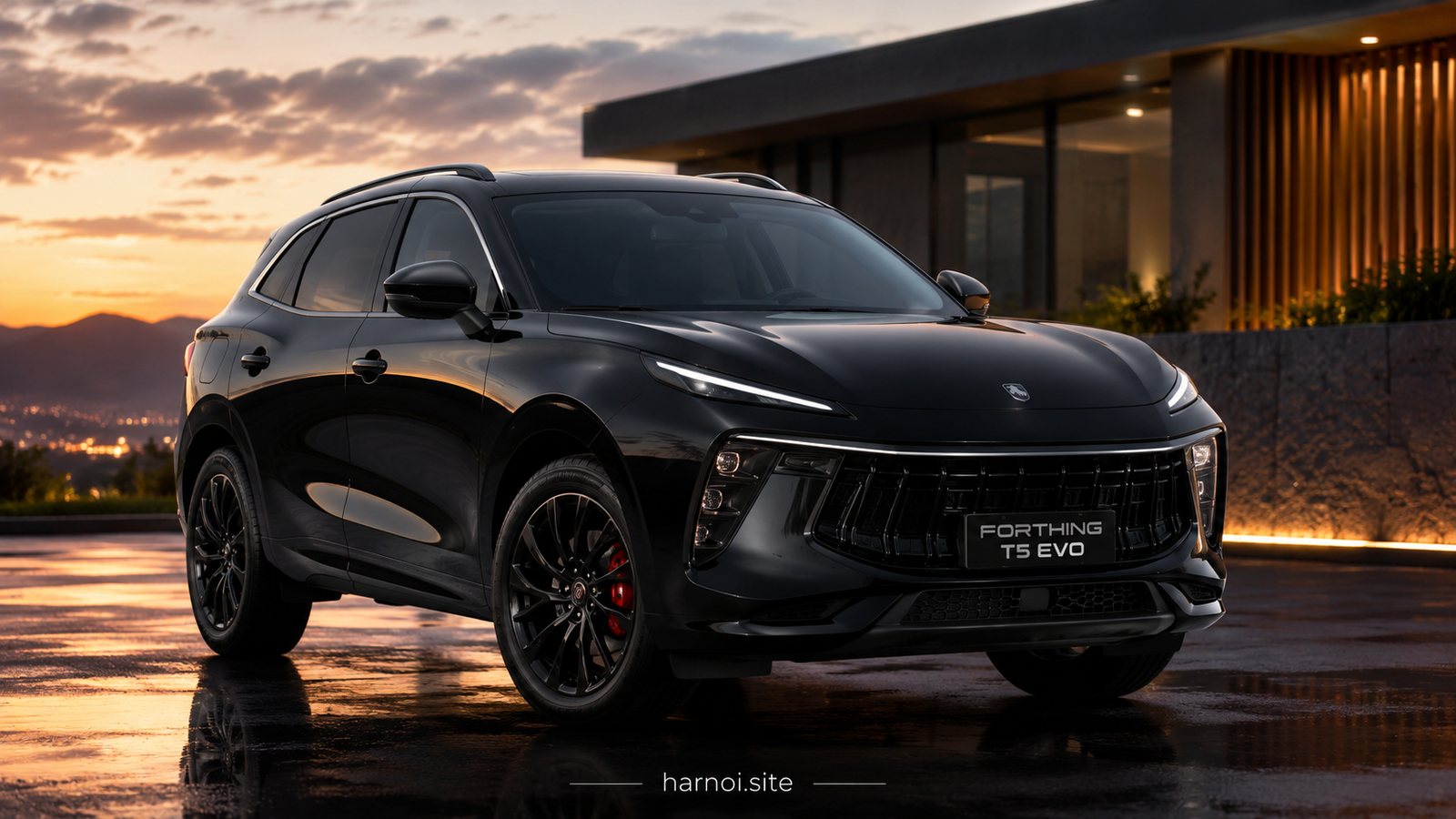
The Forthing T5 EVO is a compact crossover SUV built by Dongfeng Liuzhou Motor under the Forthing sub-brand, part of the wider Dongfeng Motor Group. Originally unveiled at the 2020 Guangzhou Auto Show as a sportier evolution of the standard Forthing T5, the T5 EVO has since become one of the brand’s best-selling exports, with a strong presence across the Middle East, Eastern Europe, and parts of Western Europe. In several European markets it’s now sold under the “Friday EV/Friday” nameplate rather than the Forthing badge.
It targets buyers who want SUV styling, a generous features list, and a low price of entry — competing loosely with the Kia Sportage, Hyundai Tucson, Toyota RAV4, Geely Coolray, and Jaecoo J7, but usually undercutting all of them by a meaningful margin.
Exterior Design
The T5 EVO leans into a bold, borrowed-from-everywhere design language: a wide front grille, sleek LED headlights, and a sculpted, sloped roofline that give it a more athletic stance than its price point suggests. Reviewers have noted styling cues reminiscent of the Volvo XC60 and even some Lamborghini Urus influence at the front end. The Sport trim adds more aggressive front and rear bumpers and carbon-fiber-look trim pieces — though these are applied as stickers over plastic rather than genuine composite material, something to be aware of if authenticity matters to you. Standard alloy wheels run 18–19 inches depending on trim, paired with 235/55 R19 or 235/60 R18 tyres.
Interior Design & Cabin Quality
Inside, the cabin favors a modern, tech-forward layout over outright luxury materials. Build quality is generally described as sturdy rather than premium — acceptable for the segment but not a match for materials found in a RAV4 or Sportage. A notable practical touch is the abundance of interior storage, with the T5 EVO offering dozens of storage spaces including hidden hooks and door pockets sized for one-litre bottles. Leather-upholstered seats are standard on higher trims, though some reviewers have found thigh support lacking for taller drivers, as the seat base appears tuned for occupants under about 180 cm.
Engine Specifications
The petrol T5 EVO is powered by a Mitsubishi-derived 1.5-liter turbocharged four-cylinder engine (1,498 cc), producing:
- Power: approximately 192–197 hp (145 kW) at 5,600 rpm
- Torque: 285 Nm
A hybrid variant, the T5 HEV (also marketed as 5 HEV), uses a different “CT-E” powertrain developed with technology derived from Citroën, aimed at markets prioritizing fuel efficiency. A fully electric sibling, the Forthing Leiting (sold internationally as the Friday EV), shares the T5 EVO’s body but swaps in a BYD-sourced electric motor and a choice of 57.8 kWh or 85.9 kWh battery packs.
Transmission & Performance
Depending on market and trim, the T5 EVO comes with either a conventional automatic gearbox or a 7-speed dual-clutch transmission (DCT). Performance is respectable rather than thrilling for the class — Wikipedia-sourced figures put the 0–100 km/h sprint at around 9.5 seconds, which is on par with many mainstream compact SUVs rather than the “sporty” positioning some marketing suggests.
Fuel Economy
Official fuel consumption figures list around 6.6 L/100 km (roughly 43 mpg imperial / 36 mpg US) on the combined cycle for the petrol engine, with some regional listings citing approximately 11 km/L. Real-world figures will vary with driving style and trim (heavier Sport variants with larger wheels typically drink a bit more).
Driving Experience
On the road, the T5 EVO is tuned primarily for comfort and everyday usability rather than outright dynamism. The suspension soaks up urban imperfections well, and the DCT-equipped versions shift smoothly under normal driving. It’s an easy car to place in traffic thanks to its compact footprint, though it won’t reward drivers looking for sharp, engaging handling the way some rivals do.
Technology & Infotainment
Higher trims get a well-equipped tech package: a 10.25-inch digital instrument cluster paired with a matching 10.25-inch touchscreen infotainment display, smartphone connectivity, and — on later model years — a companion app that allows remote engine start and lock/unlock functions. Some owners have reported occasional Bluetooth audio dropouts (calls working but music or navigation audio failing to route through), and a handful of long-term users note the infotainment system’s responsiveness can degrade after a few years of use.
Safety Features
The safety equipment list is genuinely extensive for the price bracket:
- Multiple airbags (front, side, curtain depending on trim)
- ABS with Electronic Brakeforce Distribution (EBD) and Brake Assist
- Electronic Stability Control / Vehicle Stability Control
- Traction control
- Hill start assist and hill hold assist
- 360-degree camera and rear parking sensors/camera
- Lane departure warning and lane change indicators (newer model years add lane-keep assist and lane-tracing assist)
- Blind-spot warning
- Forward collision warning and automatic emergency braking (later model years)
- Adaptive cruise control (later model years)
- ISOFIX child seat anchors
- Tyre pressure monitoring, engine immobilizer, and anti-theft alarm
That said, independent reviewers consistently flag that while the checklist is long, the calibration and consistency of the more advanced driver-assistance systems (ADAS) still lag behind established Japanese and Korean rivals.
Comfort & Practicality
The cabin is spacious enough for five adults with reasonable legroom front and rear, and the large number of storage cubbies makes it practical for daily family use. Power-adjustable front seats (8-way driver, 4-way passenger) and ambient lighting appear on the top trim, along with an acoustic-insulated hood on some versions to reduce cabin noise.
Cargo Space
Boot space is competitive for the compact SUV class, comfortably swallowing luggage for a small family, though exact published cargo volume figures vary by market listing and aren’t consistently disclosed across all sources — worth confirming with a local dealer for your specific trim.
Dimensions
Approximate dimensions (may vary slightly by market/trim):
- Length: 4,565 mm
- Width: 1,860 mm
- Height: 1,690 mm
- Wheelbase: listed at 4,565 mm in some regional spec sheets (likely a data error in the source; expect a wheelbase closer to 2,700 mm for a vehicle of this footprint — confirm with official regional specs)
- Seating capacity: 5
- Fuel tank capacity: approximately 55 L
Ride Quality & Handling
Ride quality is generally praised as comfortable and well-damped for city and highway use, with the suspension tuned toward absorbing bumps rather than delivering sharp feedback. Handling is competent and predictable rather than sporty — appropriate for the target buyer (urban families and young professionals) rather than enthusiasts.
Maintenance & Reliability
Forthing/Dongfeng has been building a reputation for reasonably dependable vehicles, and owner sentiment on the T5 EVO is generally positive, particularly from owners who’ve covered 40,000–60,000 km without major mechanical issues. As with any relatively new entrant to a given market, though, service network maturity, parts availability, and long-term resale value remain bigger question marks than they would be for an established Japanese or Korean brand — worth investigating locally before buying.
Common Problems
Based on owner forums and regional review sites, the most frequently reported issues include:
- Infotainment glitches: Bluetooth audio (music/navigation) occasionally failing to play even though calls work; general system responsiveness reportedly declining after several years of use.
- Keyless/remote-start quirks: Some owners report the engine stalling on gear engagement when started remotely via the companion app, with push-start also failing intermittently afterward.
- Battery drain: A small number of reports describe the 12V battery losing charge and the doors becoming unlockable (mechanical key required) after just a couple of days without driving.
- Unusual engine noise: A few owners mention a repetitive knocking or ticking sound developing after a period of ownership, worth having checked under warranty.
- Idle/RPM behavior after refueling: Isolated reports of RPM not rising normally immediately after a fill-up.
None of these appear to be widespread, catastrophic failures — they read more like the kind of software and electrical teething issues common to newer Chinese-market entrants — but they’re worth asking a dealer or current owner about before purchase.
Pros and Cons
Pros:
- Aggressive pricing relative to established rivals
- Long standard features and safety-equipment list, even on mid-range trims
- Spacious cabin with abundant interior storage
- Comfortable, city-friendly ride quality
- Strong turbocharged engine output (192–197 hp) for the class
Cons:
- Infotainment reliability and long-term software support are inconsistent
- Faux carbon-fiber trim and some cabin materials feel a step below segment leaders
- Seat design better suited to shorter occupants
- ADAS calibration doesn’t yet match Japanese/Korean competitors
- Resale value and long-term parts support are unproven in newer markets
Price & Value for Money
Pricing varies significantly by market:
- Saudi Arabia: approximately SAR 97,900–99,900
- UAE: approximately AED 110,000 (roughly AED 1,556/month with a 20% down payment over 60 months)
- Europe (T5 EVO/Friday EV petrol): starting around €27,490, undercutting the Kia Sportage (~€35,190) and Toyota RAV4 (~€40,000) by a wide margin
At these price points, the T5 EVO’s feature list — 360-degree camera, dual 10.25-inch displays, leather seats, and a long list of safety equipment — represents strong nominal value. The trade-off is the usual one with newer Chinese-market entrants: you’re getting more equipment per dollar, but with more uncertainty around long-term reliability, resale value, and dealer support than an established rival would offer.
Who Should Buy the Forthing T5 EVO?
The T5 EVO makes the most sense for:
- Budget-conscious families who want SUV styling and a long features list without a premium price tag
- Urban and suburban commuters who prioritize comfort over performance
- Buyers in markets where Forthing/Dongfeng has an established dealer network and warranty support
- First-time SUV buyers who won’t push the vehicle hard and value equipment-per-dollar over outright refinement
It’s a harder sell for buyers who prioritize proven long-term reliability, strong resale value, or engaging driving dynamics — in those cases, a Kia Sportage, Hyundai Tucson, or Toyota RAV4 remains the safer, if pricier, choice.
Competitors
- Kia Sportage
- Hyundai Tucson
- Toyota RAV4
- Geely Coolray
- Jaecoo J7
- Bestune T99
- BAIC BJ30
- EXEED LX
Final Verdict
The Forthing T5 EVO is a solid example of how far value-oriented Chinese SUVs have come: bold styling, a genuinely long safety and features list, a competent turbocharged engine, and pricing that undercuts established rivals by a wide margin. It’s not a car built to out-handle or out-refine a RAV4 or Sportage, and its infotainment software and long-term reliability track record are still less proven than those of legacy competitors. But for buyers who weigh equipment and price heavily and can tolerate some rough edges in software polish, the T5 EVO is a reasonable and increasingly popular choice in the compact SUV segment.
Frequently Asked Questions (FAQs)
Is the Forthing T5 EVO available with a diesel engine? No. The T5 EVO is offered exclusively with petrol (and in some markets, hybrid or fully electric) powertrains.
What transmission options are available? Depending on market and trim, the T5 EVO is offered with either a standard automatic transmission or a 7-speed dual-clutch transmission (DCT).
How much horsepower does the T5 EVO have? The turbocharged 1.5L engine produces approximately 192–197 hp and 285 Nm of torque, depending on the source and model year.
Does the T5 EVO have advanced driver-assistance features? Yes — later model years include lane-keep assist, forward collision warning, adaptive cruise control, blind-spot monitoring, automatic emergency braking, and a 360-degree camera, though calibration is reportedly less refined than in established rivals.
Is the Forthing T5 EVO reliable? Early owner feedback is largely positive for the mechanical side of the car, with several owners reporting trouble-free ownership past 40,000–60,000 km. The most commonly reported issues relate to infotainment software and occasional electrical quirks rather than major mechanical failures.
How does the price compare to mainstream rivals? The T5 EVO is priced meaningfully below competitors like the Kia Sportage and Toyota RAV4 across most markets where it’s sold, while offering a comparable or longer standard features list.
Is there an electric or hybrid version? Yes. The Forthing Leiting (sold internationally as the Friday EV) is a fully electric variant sharing the T5 EVO’s body, and a hybrid T5 HEV variant is also available in select markets.
Leave a Reply